
Reviewed · HISTORICAL TOURS
Cruise Shore Excursion – Private Tuk Tuk Tour to the Historic Center
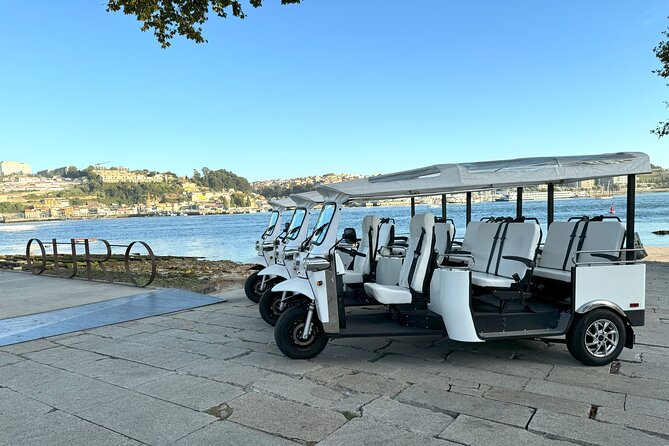
Porto hits you fast, then it keeps surprising you. This private 3.5-hour tuk tuk tour is built for cruise-day time, sliding through narrow streets and viewpoint stops that feel like a local drive, not a bus loop. I especially love the personal pace the driver and guide create, with live commentary and smart breaks for photos and short looks. One thing to keep in mind: entrances are not included, so if you want inside stops at towers, churches, or the famous bookstore, you’ll pay extra and need to plan your timing.
I also like the lineup of places that explain Porto’s identity, from seafaring details and a rope-maker garden to the Douro bridges and Ribeira waterfront views. It’s the kind of route that helps you understand why people fall for this city, even if you only have a few hours. The main drawback I noticed in the feedback is that a truly private setup can depend on operations, and a few issues came up with communication or sharing the tuk tuk, so you should confirm meeting details and vehicle expectations before you show up.
In This Review
- Key Highlights You’ll Feel Right Away
- A Private Tuk Tuk That Actually Fits a Cruise Schedule
- From Seafaring Sculpture to Jardim de João Chagas
- Passeio das Virtudes and the River View That Clarifies Everything
- Porto’s Old Center Through Photography, Gardens, and Two Icons
- Tile-Church Stops: Clérigos Area to Church of Gold
- Ribeira Waterfront, Palácio da Bolsa, and Porto’s Bridge Belt
- Batalha, Teatro São João, Chapel Tiles, and the Bolhão Market Reality
- Port Wine, Time Management, and Buying the Right Tickets
- Should You Book This Porto Shore Excursion?
- FAQ
- How long is the private tuk tuk tour to Porto’s historic center?
- Is pickup from the cruise port included?
- Does this tour include tickets to monuments?
- What’s included besides the tour itself?
- Is the tour truly private?
- What languages are the tour commentary offered in?
- When does the tour start relative to the ship arrival?
- Where do you end the tour?
- Is cancellation free?
Key Highlights You’ll Feel Right Away
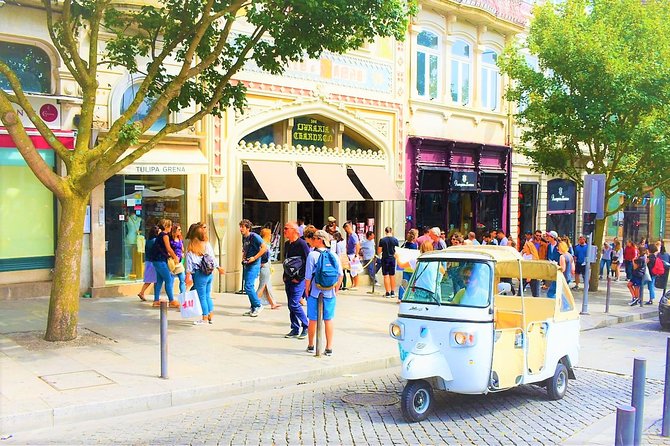
- Tuk tuk access in Porto’s tight streets, where cars and buses often can’t go
- Big-sightseeing, short-walk timing, ideal when you are fighting a cruise schedule and hills
- Douro views from multiple angles, including major bridge panoramas
- Iconic stops with context, like Torre dos Clérigos and Lello, plus lesser-known church tile details
- Port wine tasting included, served as a small tasting pour at a viewpoint stop
- Guides who tailor the ride, and names that repeatedly show up in good reviews include Anna, Ana, Gonçalo, Fabio, and Gabriella
A Private Tuk Tuk That Actually Fits a Cruise Schedule
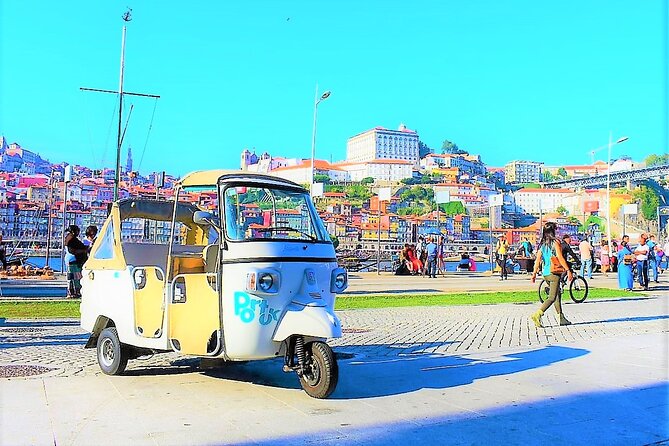
Porto is hilly, and that can ruin a cruise day if you rely only on walking. I like this tuk tuk format because it keeps you moving without turning every stop into a steep workout. You also get live commentary from your driver and guide, so you are not just collecting photos, you are building context as you go.
This is a private tour, meaning your group stays together. In real-world terms, that usually translates into less waiting, fewer “stand here while everyone catches up” moments, and more time to look around at the places that matter to you. The ride length is about 3 hours 30 minutes, long enough for a solid orientation but short enough to stay realistic when your ship is the clock.
One practical note: tuk tuks are small. If you are traveling as a bigger group, you may feel cramped, especially on bumpy cobblestone stretches. I would take that seriously if you have back issues or prefer extra space.
More Boat Tours in Porto
- From Porto: Douro Valley w/ Boat Tour, Wine Tasting & Lunch★ 4.7 · 19,061 reviews
- Complete Douro Valley Wine Tour with Lunch, Wine Tastings and River Cruise★ 5.0 · 12,920 reviews
- Porto: Six Bridges Cruise★ 4.2 · 11,680 reviews
- Porto: Douro Valley with Winery Lunch, Tastings & Cruise★ 4.7 · 7,002 reviews
From Seafaring Sculpture to Jardim de João Chagas
Your route starts with Porto and the nearby industrial and seafaring story. Early on you see a sculpture concept designed around Porto and Matosinhos maritime heritage, with net references to the fishing industry and pole colors that mimic local smokestacks and lighthouses. It is a quick “why Porto looks the way it does” moment, before the city turns into classic tourist highlights.
Next comes a hexagonal granite tower with a red balcony and lantern. It is the kind of stop that feels like a visual bookmark, not a time sink, and it sets up the theme you will see again and again: stone, industry, and maritime Porto.
Then the tour slows down in a place that feels almost like a pocket world. In the Cordoaria Garden, also known as Jardim de João Chagas, you get a real mix of architecture and playful surprises: a palm grove setting, granite fountains linked to older convents, Nasoni obelisks, and a small romantic chalet built in 1874. There is even a miniature golf area, which sounds odd until you are standing there and realizing it is just another example of how the city blends “grand” and “everyday.”
You also get a bandstand for philharmonic concerts at times, plus an Art Nouveau public bathroom from 1910 that is decorated with tile work and English-style finishings. If you like details, this is one of your best stops, because you can linger without feeling like you missed the tour.
Finally, you reach the Arrábida Bridge area, one of those “engineer bragging rights” sights. It is a reinforced concrete arch bridge designed by Portuguese engineer Edgar Cardoso and inaugurated in 1963. The bridge span was the largest concrete-arch span in the world when it opened, and the views from the river corridor help you understand why Porto’s geography is such a big deal.
Passeio das Virtudes and the River View That Clarifies Everything
At Passeio das Virtudes, the payoff is immediate. You get an excellent look over the Douro down toward where it meets the sea, and you can spot the Fountain of Virtudes plus terraces that descend toward São Pedro de Miragaia. Along the river, the former Customs House building helps you connect the river to trade and shipping, which is basically Porto’s original superpower.
This is a stop where you can stand, take in the layers, and then decide what you want to explore later. If you are the type who likes to orient yourself first, this is a great place to do it. If you only want quick photos, you can still get plenty done in the allotted time.
Porto’s Old Center Through Photography, Gardens, and Two Icons
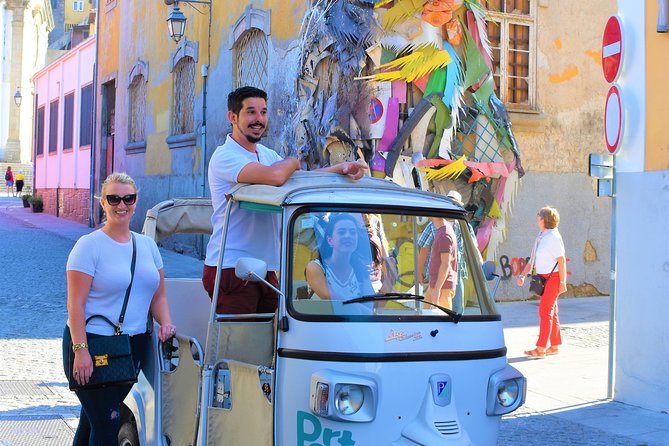
Your tour then swings back into historic-center territory, with stops that mix architecture, art, and famous names.
One highlight is the Portuguese Centre for Photography in a granite building originally dating from 1582 and rebuilt later in a neo-classical style. The building is polygon-shaped, with a geometric window count, and it has a strong historic thread, including stories of famous inmates held there, like writer Camilo Castelo Branco and the famous thief Zé do Telhado. It is not just “a building,” it is a place that shows how Porto reused stone and space through centuries.
Then you return to the atmosphere of the Cordoaria Garden area again, because it is that good for orientation. You can see statues tied to local literary figures, plus more modern sculpture works. The rope-maker history also matters here: rope making was centered in the garden area for about 200 years, which explains why this neighborhood turned into a public park in the first place.
Next up is Torre dos Clérigos, Porto’s baroque vertical landmark. The climb is famously steep, about 240 steps, but the top gives you the kind of panorama that makes Porto’s layout click. One practical detail: admission is not included, so if tower views are a priority, budget extra. The complex also features a multi-sensory facility that simulates the climbing experience, and the tower building holds art and religious collections in its context spaces.
From the tower, it is a short jump to Livraria Lello, the Art Nouveau bookshop that often tops visitor wish lists. The facade is the big visual draw, and inside you can see the painted plaster interior, plus a dramatic staircase and stained glass skylight with the library monogram and motto, Decus in Labore. Admission is also not included, so if you want inside time, plan for crowds. Some cruise visitors find it helps to buy skip-the-line tickets online in advance.
If towers and bookshops feel like too much, you still get a strong sense of Porto’s creative personality here. And if you do go inside, you get a reminder that Porto’s “wow” is often design and craftsmanship, not only scenery.
Tile-Church Stops: Clérigos Area to Church of Gold
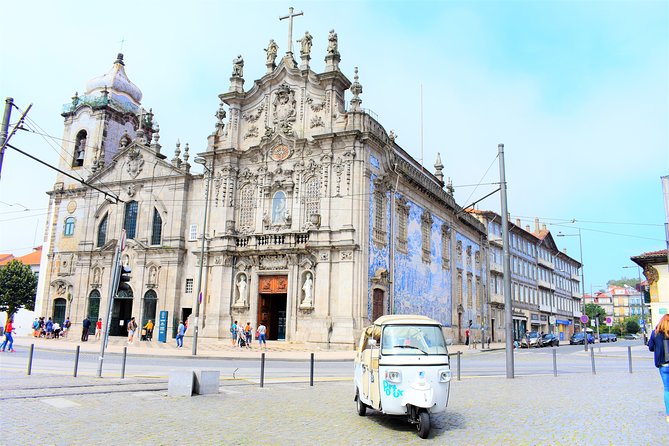
Between the iconic stops, you get a run of smaller religious and architectural moments that many first-time visitors skip.
You will see Fonte dos Leões, the Fountain of the Lions. It is a 19th-century fountain cast by the Val d’Osne foundry in France, and it is mostly a copy of the fountain in Leicester, England. It is quick, but it helps you notice how Porto’s cityscape is not just locally made, it also reflects international influence.
Next, churches bring you into the tile and rococo details. In Igreja do Carmo, you get a rococo standout with carvings inside, and later you see the lateral façade covered with tiles. The tile drawings reference Our Lady, based on designs by Silvestre Silvestri. This is one of those stops where 10 minutes can still be enough if you know what you are looking for: the way tile patterns tell religious stories.
Then Igreja dos Carmelitas adds another baroque layer. The classical façade is from the mid-1800s, and the church dates back to the 1600s. You get national monument status, plus a Porto rococo altarpiece that is described as stylistically revolutionary.
The tour culminates in Igreja de São Francisco, often called the Church of Gold for its gilded interior from the 17th and 18th centuries. The carved wood richness is what people remember, along with the Tree of Jesse and the catacombs. Admission is not included, so treat this as either a look-from-outside moment or a planned ticket stop based on your time and energy.
More Private Tours in Porto


Ribeira Waterfront, Palácio da Bolsa, and Porto’s Bridge Belt
Now the route turns toward Porto’s waterfront story and the trading power behind it.
In the square area around Mercado Ferreira Borges and Palácio da Bolsa, you can see the Monument to Infante D. Henrique, built to celebrate the 500th anniversary of his death, with construction started in 1894 and completed in 1900. It is another “why this city mattered” reminder.
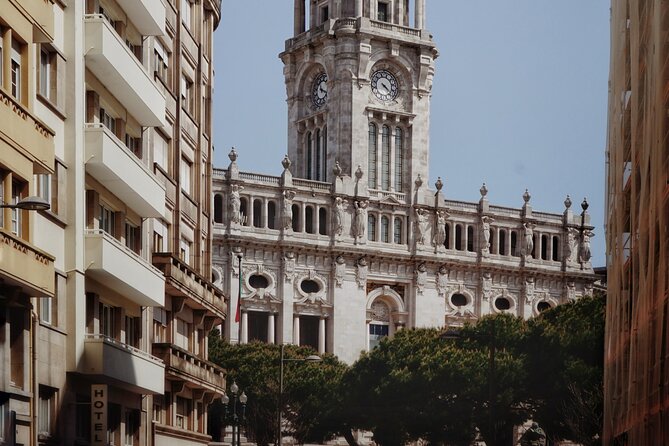
Palácio da Bolsa is one of the biggest stops here. It is a national monument and the headquarters of the Commercial Association of Porto, designed in a neoclassical style in 1842. The Arabian Room is the major highlight, and the palace is also part of the Urban Wine Route. Admission is not included here either, so if you want the Arabian Room in particular, you should assume you’ll need to pay separately.
Then you move to Mercado Ferreira Borges, an iron architecture example built in 1885 and later renovated into an entertainment venue, where Hard Club is now located. This is a fun architectural pause, especially if you like the look of ironwork in daylight.
After that, you reach the famous D. Luís I Bridge, planned by engineer Teófilo Seyrig, a disciple of Eiffel. It was inaugurated in 1886 and has two overlapping iron decks, with the metro using the upper deck today. The bridge is about 395 meters long, and its forged iron arch is described as the world’s biggest of its class when it was built.
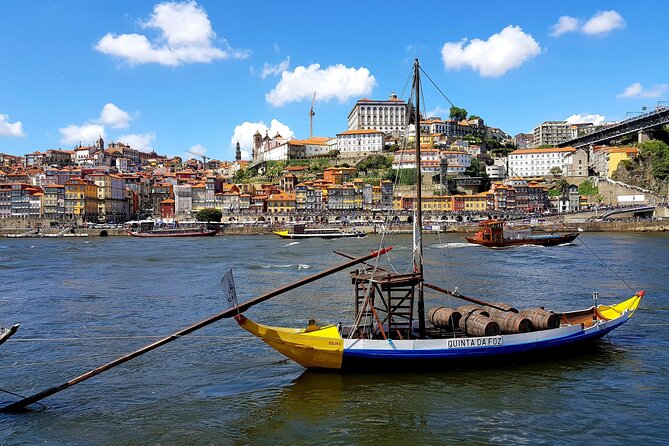
Then the tour gets to Praça da Ribeira, one of the oldest squares cited since medieval times. You see the fish-market vibe and the commercial energy, plus fountains and historic wall remnants. There is nightlife here, and even if your tuk tuk can’t enter the square, you get the right stop context to walk a bit and feel the waterfront mood. Admission is free here because you are outside.
From Ribeira, the view expands at Mosteiro da Serra do Pilar. It is a UNESCO World Cultural Heritage site built from 1538 to around 1670, with a circular church plan and a dome encircled by a balcony. The cloister has 36 Ionic columns and is described as the only example in Portugal. The big reason to stop is the terrace viewpoint, which lets you see the riverside stretch in both directions, including the old center and the major bridges.
Finally, you look toward the Ponte do Infante, inaugurated in 2003 and designed by engineer Adão da Fonseca. It replaced the upper deck lane of D. Luís I Bridge, now used by the metro line. The arch span of 280 meters is noted as a world record, and the bridge is considered especially elegant for its type. You get the city scale without needing to climb a hill.
Batalha, Teatro São João, Chapel Tiles, and the Bolhão Market Reality
The day continues toward Praca da Batalha, dominated by the monument to D. Pedro V and framed by cultural buildings like São João National Theatre and Cine-Teatro Batalha. This square is a “street crossing” stop that also helps you understand how Porto reshaped areas after earlier city walls and sieges.
Nearby, you see the Teatro São João building, constructed in 1910 on the ruins of the earlier Real Theatre that burned in 1908. The building’s façade includes stylistic emblems tied to pain, quality, hate, and love, and it is designed by Marques da Silva. This stop is mostly for architecture awareness, not a long show break.
Then there is a chapel stop with tiles that cover the exterior and depict scenes from the life of St. Francis of Assisi and St. Catherine. Those tile panels were recovered in 1982. Again, it is short, but it is the kind of detail that makes Porto feel lived-in.
The tour often ends by passing by Bolhão Market, Porto’s best-known market building. It dates to 1850 and has neoclassical structure across two floors. It is currently closed for refurbishment works, so you should expect to see it from the outside rather than shop inside during this excursion.
Port Wine, Time Management, and Buying the Right Tickets
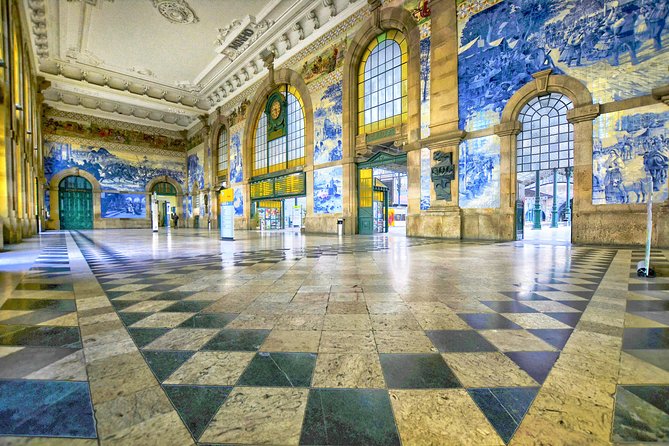
The port wine is included as a Port wine glass. In practice, it is not served as a sit-down bar stop. Many cruise visitors describe it as a tasting poured at a viewpoint stop from a bottle, using a small tasting cup. It is a nice “Porto starter” without taking half the day.
Now the real value question is: what does the $106.93 per person price buy? For this cost, you are paying for a private tuk tuk, a driver and guide with live commentary, and a tightly timed route that covers major landmarks you would struggle to string together in a limited cruise window. You are also paying for the convenience factor, especially if you do not want to climb from one end of the center to the other.
What you should not assume: monument entrances are not included. That affects places like Torre dos Clérigos and Livraria Lello, plus other churches in the route. If you are the type who wants to go inside every famous stop, you might spend extra and you may feel a bit rushed. If you pick one or two interior priorities, the tour feels like a great orientation plus a few ticketed splurges.
One more heads-up from the feedback: the tour is designed as sightseeing-first, with limited shopping time. If your main goal is browsing shops for textiles, ceramics, or leather, you might want to pair this with a separate half day where you can roam without time pressure.
Should You Book This Porto Shore Excursion?
Book it if you want a fast, well-paced introduction to Porto that mixes big icons like Torre dos Clérigos and Livraria Lello with river views, bridges, and church interiors you might not prioritize on your own. It is especially worth it when your cruise day is short and you want to avoid steep walking.
Consider another option if you care mainly about long shopping stops, because this route is built around highlights and views. Also, if you are a group bigger than what a small tuk tuk usually fits, or you have mobility or comfort concerns on cobblestones, check suitability carefully before you commit.
If you do book, do one smart thing: confirm your pickup details and timing clearly before you depart the ship. A smooth meet is what makes tuk tuk days work.
FAQ
How long is the private tuk tuk tour to Porto’s historic center?
The duration is listed as approximately 3 hours 30 minutes.
Is pickup from the cruise port included?
Pickup is offered. Pickup is from the main gate at Leixões Port, Matosinhos Port, and Doca Norte. The guide picks up at the pier outdoor gate.
Does this tour include tickets to monuments?
No. Monuments entrance tickets are not included.
What’s included besides the tour itself?
Included items are the driver/guide, live commentary on board, a local guide, and an alcoholic beverages Port wine glass.
Is the tour truly private?
Yes, it is described as a private tour/activity, with only your group participating.
What languages are the tour commentary offered in?
English is offered.
When does the tour start relative to the ship arrival?
The tour starts no later than 1 hour after the ship arrives.
Where do you end the tour?
This activity ends back at the meeting point.
Is cancellation free?
Free cancellation is offered, with full refund if you cancel at least 24 hours in advance of the experience’s start time. Refund is not issued if you cancel less than 24 hours before the start time.
Engine Low, Coast Close
- Porto: 6 Bridges Douro River Cruise
★ 4.3 · 6,472 reviews - From Porto: 2 Wine Regions, Farm-to-Table Lunch & Boat
★ 4.9 · 5,724 reviews - Authentic Small Group Douro Wine Tour with Lunch & River Cruise
★ 5.0 · 4,775 reviews
More Historical Tours in Porto
- Douro Valley: Historical Sites, Wine Experience, Lunch & Cruise
★ 5.0 · 5,133 reviews - Porto: An Intimate Fado Show in a Historical Tavern
★ 4.8 · 2,055 reviews - Porto: Historic City Center Walking Tour
★ 4.7 · 1,172 reviews
More Tuk Tuk Tours in Porto
- Porto: Guided Tour by Tuk-Tuk & Optional Douro River Cruise
★ 4.5 · 5,980 reviews - Porto: Guided Tuk Tuk Tour
★ 4.6 · 1,390 reviews - Historic Porto by Private Electric Tuk Tuk to Top Landmarks
★ 4.5 · 735 reviews
What Porto sent us most recently
- Bike or E-Bike Tour of Porto and Atlantic Coast
★ 5.0 · 39 reviews - Porto: Premium Douro Valley Small-Group Tour, Cruise & Lunch
★ 4.9 · 39 reviews - Off the Beaten Track in Porto: Private City Tour
★ 5.0 · 39 reviews - Porto: Graham’s Port Lodge Tour and Port Essentials Tasting
★ 4.9 · 39 reviews - Porto: 50-Minutes Rabelo Boat Cruise on the Douro River
★ 3.8 · 39 reviews - Port : Small-Group 6 Bridges, Douro River Sunset Cruise w/ Drink
★ 5.0 · 39 reviews - Museu das Marionetas do Porto
★ 4.5 · 39 reviews - Porto Sunset Bike Tour
★ 4.5 · 39 reviews
Historical Tours, compared.
Historical Sites, Wine Experience, Lunch & Cruise
Read our review →
Daytime or Sunset Boat Cruise with History and Wine
Read our review →
Private Tour of the Historic City in a Ford T Car
Read our review →
Browse the lists this tour appears in