Reviewed · THINGS TO DO IN LISBON
Discover Bairro Alto’s Hidden Gems and Stunning Viewpoints
Lisbon tells stories if you walk slowly. This 2.5-hour Bairro Alto tour connects you to old Lisbon in a way you can actually see: Rossio Station’s strange, temple-like façade, the life of Luís de Camões, and the hill history that shaped the neighborhood.
What I like most is the way the guide turns streets into a timeline, from royal railway design details to plague-era planning in Bairro Alto. I also really enjoyed ending near Largo do Carmo for that “wait, Lisbon has views everywhere” feeling. One thing to consider: it is a walking tour with moderate fitness, so expect hills and plenty of stairs in this part of town.
In This Review
- Key Highlights You Should Not Miss
- Getting Oriented at Praça Dom Pedro IV, Then Moving Upward
- Rossio Train Station: Neo-Manueline Architecture That Feels Like a Temple
- Camões Square Makes Lisbon’s Literature Feel Physical
- Bairro Alto’s Hill: Walls, Plague Victims, and a Hermitage Story
- Largo do Carmo and the Carmelite Vow Behind the Church
- Price, Time, and Why This Tour Is Good Value at a Glance
- Included and Not Included: What to Plan Around
- A Few Practical Tips for Lisbon Walking in This Area
- Who This Bairro Alto and Viewpoints Walk Best Fits
- Should You Book This Tour or Keep Planning?
- FAQ
- Where does the tour start?
- Where does the tour end?
- How long is the experience?
- What is the price per person?
- Is the tour ticket mobile?
- What language is the tour offered in?
- What is included in the tour price?
- What is not included?
- Is there a group size limit?
- What are the cancellation rules?
Key Highlights You Should Not Miss
- Neo-Manueline Rossio Station, built like a grand set-piece (horseshoe portals included)
- Luís de Camões square markers, with the story behind Os Lusíadas
- Bairro Alto’s shift from wealthy lanes to plague-era living patterns
- Saint Roque relic story, tied to King Manuel I and a hermitage near the cemetery
- Carmo church and convent legend, linked to Nuno Álvares Pereira and the Battle of Aljubarrota
- A strong end point near Santa Catarina, useful for grabbing viewpoints before you move on
Getting Oriented at Praça Dom Pedro IV, Then Moving Upward
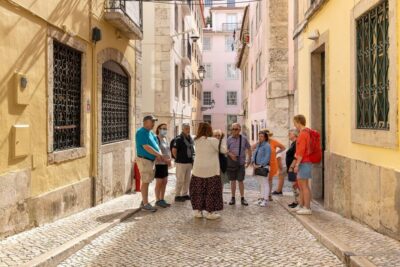
The tour starts at Praça Dom Pedro IV in the Rossio area. This is a smart move, because Rossio is one of Lisbon’s central “decision points.” You get your bearings fast, and the walk naturally guides you away from the big main roads and toward the older, more layered streets up the hill.
From here, you’re not just wandering. You’re going step by step along a route that links landmarks to bigger themes: how Lisbon grew, how it rebuilt after destruction, and how the city’s power and population shifts shaped the street grid. The stop at the square is free and short, about 25 minutes total for this first leg, which means you won’t burn the morning on waiting around.
If you like walking tours that give you context while you stroll, this pacing works.
More Things to Do in Lisbon
- Lisbon City Center Tour – The Unmissable Lisbon★ 5.0 · 22,234 reviews
- Lisbon: Sintra, Pena, Regaleira, Cabo da Roca & Cascais★ 4.7 · 19,656 reviews
- Lisbon Card: 24, 48, or 72-Hour Pass★ 4.5 · 17,944 reviews
- Lisbon: Jerónimos Monastery Entrance Ticket★ 4.1 · 14,164 reviews
Rossio Train Station: Neo-Manueline Architecture That Feels Like a Temple
At Estação do Rossio, you get a rare treat: a major Lisbon landmark where the outside already tells a story. The façade is Neo-Manueline, a Romantic recreation of the earlier Manueline style associated with Portugal’s early 1500s look, when everything felt grand and decorative.
Here are the facts worth filing away because they make the building easier to “read”:
- The station was commissioned by the Portuguese Royal Railway Company.
- It was designed between 1886 and 1887 by architect José Luís Monteiro.
- It was completed in 1890.
- The most eye-catching detail at the entrance is a pair of intertwined horseshoe portals.
And yes, the design choice is the point. The outside feels more like a temple than a typical train station. If you are the kind of person who notices style, symbols, and materials, you’ll enjoy standing close enough to take in how dramatic the entrance is, then mentally placing it in Lisbon’s 19th-century push to connect to other regions, including the route toward Sintra.
Practical note: admission here is free, so you’re mostly paying for the guide’s interpretation.
Camões Square Makes Lisbon’s Literature Feel Physical
Next you hit Praça Luís de Camões. This stop is short, about 30 minutes, but it lands well because it connects a name you might recognize from a classroom to a street-level landmark.
You learn that Luís de Camões was Portugal’s national poet and the author of the epic poem Os Lusíadas, which describes Vasco da Gama’s sea route to India. That alone is a big cultural anchor, but the details make it feel human:
- Camões is said to have lost one eye in a battle in Ceuta.
- His influence is so deep that Portuguese is sometimes called the language of Camões.
This is one of those stops where the guide helps you look at the square as a piece of national identity. It also serves as a transition point, because it sets up the next area, where Lisbon’s growth and planning show up in the hillside streets of Bairro Alto.
If you don’t care much about poetry, you’ll still likely enjoy this stop because it explains why names like this matter in Lisbon. City naming is not random.
Bairro Alto’s Hill: Walls, Plague Victims, and a Hermitage Story
Then you move into Bairro Alto, and the conversation shifts from famous people to how a city handles pressure.
The guide frames this area through the lens of growth after Portugal’s discovery era. By the late 15th century, Lisbon was crowded with people from all over, and the center needed expansion. The spot around what is now Camões square is described as having once been part of the city’s entrance area.
You also get a clear sense of how the boundary lines worked. Earlier, there were parts like:
- the Fernandine wall
- the door of Santa Catarina
- and the fact that after the earthquake, you now see churches such as Encarnação and Loreto where earlier structures had stood.
Then comes the story that gives Bairro Alto its unusual flavor. On the top of the hill, there was a cemetery of plague victims. As the Black Plague hit and the city’s demographics shifted, the less fortunate and the sick moved closer to the church.
And here is the key twist tied to royal power and religion:
- In 1506, King Manuel I requested a relic of Saint Roque from Venice.
- The relic was placed in a hermitage near the cemetery.
- Because the demand for proximity became real, the neighborhood around this church area grew in a different pattern than the wealthy zones on the other side of the wall.
The tour also notes that an urban plan was developed to receive these people.
What this means for you, standing on the street: you start seeing Bairro Alto as a place shaped by fear, policy, faith, and migration, not just nightlife and views. The guide helps you connect that to why the streets feel the way they do, and why certain areas have the density they have.
One consideration: this part of Lisbon is hilly and can feel step-heavy. Wear shoes you trust, because you’ll do more uphill walking than you might expect when you picture Bairro Alto.
Largo do Carmo and the Carmelite Vow Behind the Church
The last major stop is Largo do Carmo, about 15 minutes in the itinerary. This is where the tour leans into legend and architecture, plus it sets you up for the viewpoint end.
The church and convent trace back to 1389, built after Nuno Álvares Pereira, a general who helped King John repel Castilian troops. The story goes that before the Battle of Aljubarrota in 1385, he vowed to build what he described as the world’s most beautiful church if he defeated the Castilians.
Portugal won, and he kept his word:
- He funded the Carmelite church and convent.
- After it was completed in 1423, he joined the Carmelite order.
- He spent the rest of his life in the convent.
That is the kind of backstory that changes how you look at religious buildings. You are not just seeing stone. You’re seeing a promise turned into bricks, and the guide makes that connection clearly.
Then the tour ends at Miradouro de Santa Catarina, which matters because you’ll likely want to take a moment to enjoy the elevated perspective. Even if you already know Lisbon looks good from viewpoints, the location is convenient for turning your last stop into a real payoff, not just a check mark.
When the light changes over Lisbon, try these:



Price, Time, and Why This Tour Is Good Value at a Glance
The tour is listed at $3.61 per person and runs about 2 hours 30 minutes. That price is so low it makes you think, what exactly am I paying for?
Here’s the practical answer: the value is in the interpretation. Each of the main stops is noted as free for admission tickets, including the station and the key squares and churches. So you’re not buying your way into museums. You’re paying for a local expert guide who connects architecture, literature, and survival-era Lisbon planning into a route you can walk in one sitting.
Also, you’re getting:
- history of Lisbon’s earthquake and past destruction
- fun facts and monument context
- and discounts for booking other experiences later that same day and night
Group size is capped at 50 travelers, which is often enough to keep the tour from feeling chaotic, as long as you can hear your guide. The tour uses a mobile ticket and is offered in English. Confirmation comes at booking time, and service animals are allowed.
If you want a low-cost orientation walk with built-in “why it matters” storytelling, this is one of the better ways to spend a chunk of time in Lisbon without turning your day into a checklist of paid entry fees.
Included and Not Included: What to Plan Around
Included means you should show up ready for walking plus guided storytelling. In your kit, you want:
- comfort for a moderate walking route
- and a phone that can handle a mobile ticket
The guide also mentions earthquake history, which helps explain why some places you see today are shaped by what came later.
Not included is also useful to know because you might be expecting an elevator moment. Entry to the Santa Justa elevator is not included, and private transportation is not provided.
Contribution to the guide is listed as 10 to 20 euros. That means the tour price is clearly built around the basic tour cost, and tipping is part of the local rhythm for guided work.
A Few Practical Tips for Lisbon Walking in This Area
This route is do-able, but Lisbon is not flat. Before you head out, I’d plan for:
- solid shoes for cobblestones and steps
- a light layer for wind, especially when you reach the lookout area near the end
- water, since 2.5 hours of uphill walking can sneak up on you
Because it is near public transportation, you can also make it part of a bigger day without committing to a private transfer. That flexibility matters when you’re hopping between neighborhoods.
And since the tour is in English and limited to a max of 50 people, it’s a good option if you want a structured route but don’t want to join a massive bus crowd.
Who This Bairro Alto and Viewpoints Walk Best Fits
I think this tour fits best if you want more than views. You’re getting:
- architecture context at Rossio Station
- Portuguese cultural references through Luís de Camões
- and human city history in Bairro Alto, including plague-era living patterns and the Saint Roque relic story
It’s also a strong pick if you’re short on time in Lisbon and want a route that ties together multiple parts of the city core without requiring paid entries.
You might skip it if you’re expecting long museum time, or if you’re trying to fit in specific landmarks not mentioned in the route (like the Santa Justa elevator, which is not included).
Should You Book This Tour or Keep Planning?
If your goal is a meaningful walking route through central Lisbon with stops that teach you how the city got shaped, I’d book it. The free-admission stops plus a guide-focused route make the value feel real, not gimmicky.
I’d book it especially if you like these things:
- history that is tied to streets you can stand on
- architectural details you can point at
- and a finish that helps you enjoy Lisbon from higher ground at Miradouro de Santa Catarina
One final thought: the tour details you’ll see focus on Rossio, Camões, Bairro Alto, and Largo do Carmo. If you are shopping based on a different set of Lisbon sights, double-check that the stops you want match this route before you commit.
FAQ
Where does the tour start?
The tour starts at Praça Dom Pedro IV, 1100-581 Lisboa, Portugal.
Where does the tour end?
The tour ends at Miradouro de Santa Catarina, 1200-262 Lisboa, Portugal.
How long is the experience?
It lasts about 2 hours 30 minutes.
What is the price per person?
The price is listed as $3.61 per person.
Is the tour ticket mobile?
Yes, it uses a mobile ticket.
What language is the tour offered in?
The tour is offered in English.
What is included in the tour price?
Included features are a local expert and dedicated guide, insights about Portugal culture and history, history of the earthquake and past destruction, discounts for booking other experiences later in Lisbon, and history of famous monuments and fun facts of Lisbon.
What is not included?
Not included are contribution to the guide (10 to 20 euros), private transportation, and entry to the Santa Justa elevator.
Is there a group size limit?
Yes, the tour has a maximum of 50 travelers.
What are the cancellation rules?
You can cancel for a full refund up to 24 hours in advance of the experience start time. If you cancel less than 24 hours before, the amount paid is not refunded.
What Lisbon sent us most recently
- From Lisboa: Sintra, Cabo da Roca & Cascais Private Full Day Tour
★ 5.0 · 39 reviews - Best of Sintra and Cascais Private Full Day Tour
★ 5.0 · 39 reviews - Private Sailing tour in Lisbon – Day Time, Sunset and Night
★ 4.5 · 39 reviews - Tuk Tuk Lisboa – Sightseeing Tours
★ 4.5 · 39 reviews - Private Experience Óbidos Nazaré and Fátima or Aveiro and Óbidos
★ 5.0 · 39 reviews - Belém and Jerónimos Monastery Private Walking Tour & Ticket
★ 4.5 · 39 reviews - Lisbon Private Luxury Tour
★ 4.5 · 39 reviews - Exclusive Lisbon Progressive Dinner & Wine Tour
★ 5.0 · 40 reviews
Things to Do in Lisbon, compared.
Lisbon City Center Tour – The Unmissable Lisbon
Read our review →
Sintra, Pena, Regaleira, Cabo da Roca & Cascais
Read our review →

Sunset Boat Party Cruise with DJ and Open Bar
Read our review →
Sintra, Pena, Regaleira, Cabo da Roca, and Cascais
Read our review →