
Reviewed · TUK-TUKS
Porto Half Day Private Tuk Tuk Tour
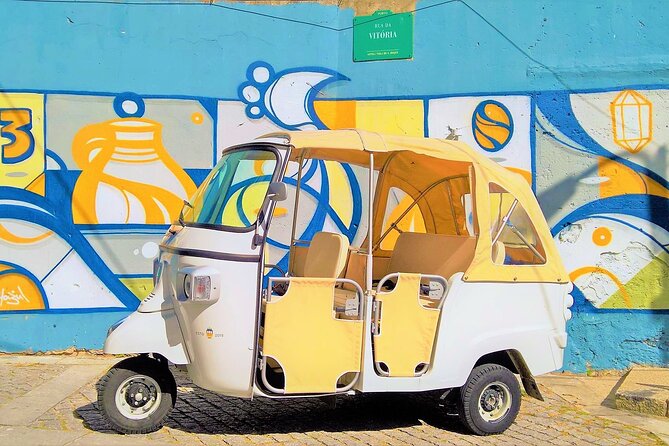
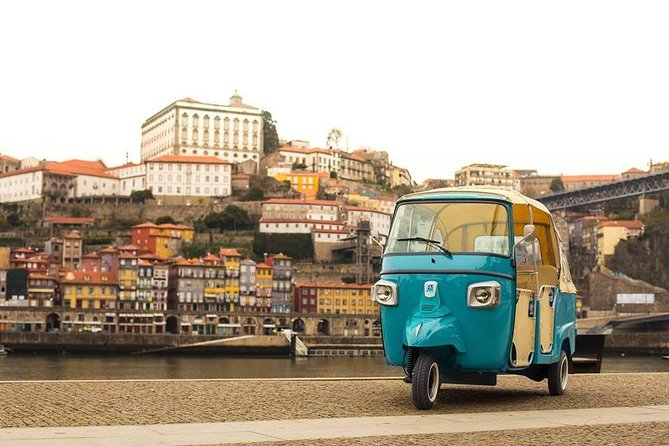
Porto looks different at tuk-tuk speed. In about 3.5 hours, you’ll zip between key neighborhoods with a driver-guide, live commentary, and an included wine tasting. I like how this route helps you see Porto and Gaia fast, and you get great photo chances without wearing out your shoes.
One thing to consider: the half-day schedule is packed, and the covered tuk-tuk canopy can limit sight lines at some viewpoints. If you love long indoor stops, you might treat this as your orientation lap, then return later for your favorites.
In This Review
- Key things to know before you ride
- Porto tuk-tuk speed, plus a real guide talking you through it
- Price and value in a half-day: what $83.48 really buys
- Starting in the historic core: São João theater, a medieval wall, and immediate context
- Serra do Pilar: the circular monastery that earns its terrace views
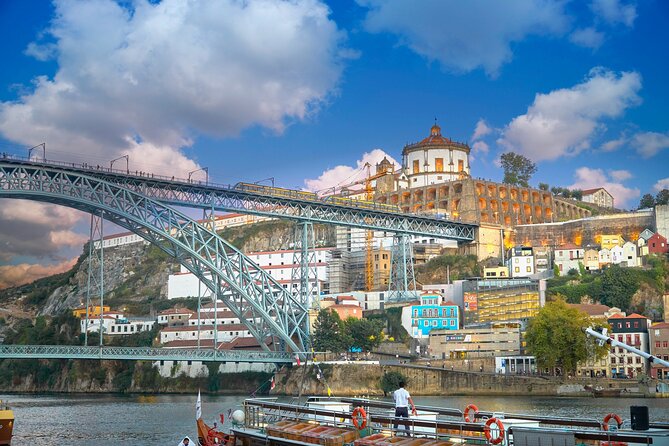
- Dom Luís I Bridge: the iron-deck icon and a transit story
- The Church of Gold vibe: gilded interiors, Tree of Jesse, and catacombs
- Palácio da Bolsa and the Arabian Room: Porto’s money-history turned spectacle
- Jardins do Palácio de Cristal: your breather before the church and garden cluster
- Ferreira Borges market area and Alfândega Nova: iron architecture and repurposed buildings
- Rococo churches and Cordoaria Garden: João Chagas Garden to Clerics Tower
- Old prison, photo center, and Livraria Lello: art-deco energy in a short window
- Wine tasting, pacing, and how to get your money’s worth
- Who this Porto tuk-tuk tour fits best
- Should you book this half-day private Porto tuk-tuk tour?
- FAQ
- How long is the Porto Half Day Private Tuk Tuk Tour?
- Is this tour private?
- What languages are offered for the tour?
- Is wine tasting included?
- Are entrance tickets included for all stops?
- What is the meeting point address?
Key things to know before you ride
- Serra do Pilar’s circular monastery with 36 Ionic columns and big terrace views over Porto and Gaia
- Dom Luís I Bridge by Teófilo Seyrig, with two overlapping iron decks and the Metro running above
- Church of Gold style interiors, including the Tree of Jesse and catacombs (yes, it’s as dramatic as it sounds)
- Arabiann Room at Palácio da Bolsa, a top Porto interior stop you can pair with a quick walk outside
- Cordoaria Garden (João Chagas Garden) and classic Porto rococo churches close together in the city center
- Livraria Lello area highlight, plus a strong Art Nouveau and neo-Gothic streetscape feel
Porto tuk-tuk speed, plus a real guide talking you through it
A tuk-tuk tour in Porto is a smart match. The city is hilly, the streets twist, and you often don’t notice how much you’re walking until you’re done. Here, you glide between stops, and your guide fills the gaps with live explanations as you move. That matters because Porto’s look can feel inconsistent at first. One block is grand and stone-polished, the next is narrow and local. The narration helps you connect the dots.
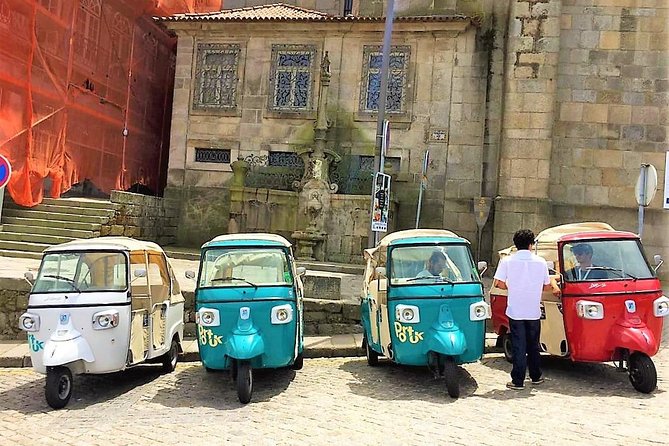
This is also a private setup. That means the guide can adapt to your pace, and you are not stuck waiting for someone who wandered into the wrong doorway. I’ve seen guides like Ana, Gabi, and Gonçalo singled out for staying engaging and conversational, not just listing dates. If you want your tour to feel like a guided walk with wheels, that’s the sweet spot.
More Private Tours in Porto
- Discover Porto’s Highlights on a 2-Hour Private Electric Tuk Tuk★ 4.5 · 1,860 reviews
- Porto PRIVATE TOUR With Locals: Highlights & Hidden Gems★ 5.0 · 984 reviews
- Porto: Private Tour of the Historic City in a Ford T Car★ 4.8 · 932 reviews
- Porto: Private tour in the Douro (1 to 4 people) on a boat just for you★ 5.0 · 744 reviews
Price and value in a half-day: what $83.48 really buys
At $83.48 per person for roughly 3 hours 30 minutes, you’re paying for three things at once: transport, guided storytelling, and wine tasting. You’re not paying for a single museum ticket and a view. You’re paying for a stitched-together experience across the historic core, river crossings, and viewpoint territory.
A key value point: many stops are free to enter, while a few major sights require tickets that are not included. From the tour details, you should expect free time at places like Serra do Pilar, gardens, and several churches, while tickets are not included for stops such as Torre dos Clérigos, Igreja do Carmo, and Livraria Lello. That means you can control your spend. If you don’t care about climbing towers or doing a longer inside visit at every stop, you’re not forced into extra costs.
So, what you get is not just convenience. It’s efficiency. You’re compressing Porto’s “most asked about” highlights into one morning or afternoon, then leaving you time to return later if something catches your interest.
Starting in the historic core: São João theater, a medieval wall, and immediate context
The tour kicks off near the center at R. de Augusto Rosa 180. From there, you move quickly into the story of Porto as a city that rebuilt itself, expanded, and kept layers.
One early stop is the São João Theatre complex, constructed in 1910 on the ruins of the earlier Real Theatre, which burned down in 1908. What I find useful about this kind of stop is that it isn’t just architecture. It explains how Porto’s civic life bounced back after disaster, and how the façade reflects a renovation style inspired by Luís XVI, typical of the early 1900s. The guide also points out emblem motifs tied to themes like pain, quality, hate, and love, which makes the building feel more like a message than a random landmark.
Right after that, you get a taste of deeper time at a Romanesque wall, built in the 12th century. It marked the administrative and urbanistic extent of Porto during a period when population had been more dispersed. You’re seeing what remains, not a fully intact wall, but that’s part of the lesson. Porto’s history survives in fragments, and a good guide helps you understand why what you’re looking at is still meaningful.
Practical tip: even if you only get a short look, listen for the “why this matters” explanation. That’s what turns a quick stop into a memory.
Serra do Pilar: the circular monastery that earns its terrace views
Most Porto tours give you a river view. This one gives you a viewpoint with a setting.
At Mosteiro da Serra do Pilar, construction began in 1538 and took until about 1670 to finish. It started for Augustinian Friars from the Monastery of Grijó, but later the monastery became part of the Civil War story of 1832 to 1834, when the liberal army settled there. The place fell into disrepair after attacks, and it only regained stability much later, tied to the Royal Brotherhood of Lady of the Pilar and then a restoration group created in 1925.
Here’s what makes this stop special in the real world: you get both architecture and a view. The church is circular in plan, with a dome and balcony. The cloister is also circular, with 36 Ionic columns, and the tour notes it as the only example in Portugal. Then you step out to a terrace where the city opens up. You can see the riverside stretching across Porto and Gaia toward the Arrábida Bridge. You also get sightlines toward the historic center, including the Cathedral and the D. Luís I bridge, plus Fontainhas and the São João bridge in the other direction.
Time on the stop is about 15 minutes, and that’s enough if you keep your plan simple: look first, then photos. Do not try to read everything like you’re studying for an exam. Take the terrace in, and let your guide fill in the key points.
Dom Luís I Bridge: the iron-deck icon and a transit story
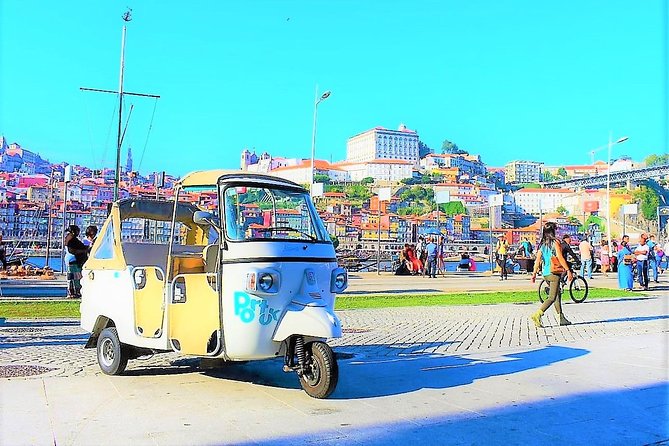
The next major connection point is the D. Luís I Bridge, planned by Teófilo Seyrig, a disciple of Eiffel. It opened in 1886 and is built with two overlapping iron decks. The tour notes it as 395 metres long and 8 metres wide, and that its arch is considered the world’s biggest one in forged iron.
What makes this bridge feel alive rather than just impressive is that it still functions as transport. The upper deck is used by the Porto Metro, connecting the Cathedral area to Garden of Morro and Avenida da República in Vila Nova de Gaia. So as you look at it, you’re also seeing how infrastructure shaped the city’s growth, day to day, not just in historic photos.
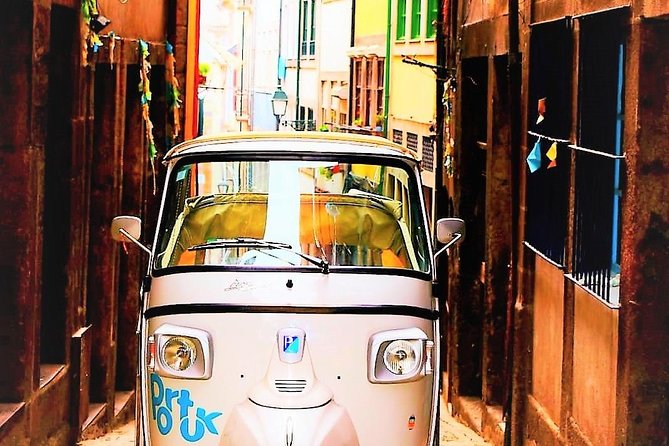
If you’re riding in rain or cold, the tuk-tuk canopy helps. But do pay attention to visibility. A few guides manage the stop-and-view moments well, while some can do more “pass-by pointing” than “actually look.” If your goal is photos of the bridge, tell your guide upfront that you want time for angles.
More Tuk Tuk Tours in Porto

The Church of Gold vibe: gilded interiors, Tree of Jesse, and catacombs
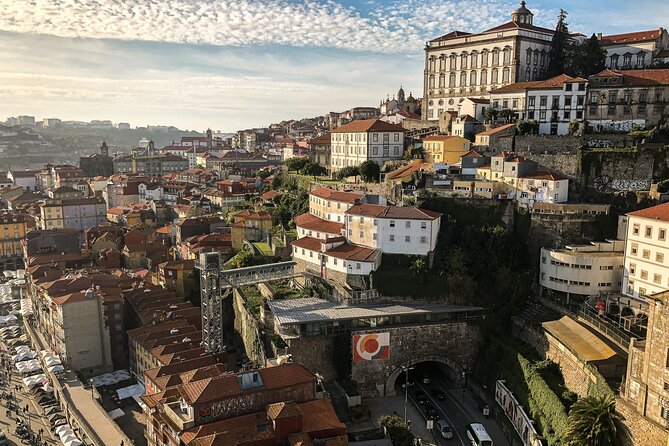
One of the standout cultural stops comes next, focused on a major Gothic temple started in the 1300s and later famous for its Baroque-era gilded interior from the 1600s and 1700s. The details in the tour description are the giveaway: a carved wood interior so exuberant that it’s been described as the Church of Gold, plus the Tree of Jesse and catacombs.
Even if you don’t buy a ticket for a longer interior visit on your own, your guide’s explanation is often what makes this feel worth the stop. It’s not just gold for gold’s sake. It’s a visual narrative tool that turns religious art into something you can practically read with your eyes.
One consideration: this tour is half-day pacing. That means your time is brief. If catacombs or long inside browsing is your thing, plan to revisit with more time later.
Palácio da Bolsa and the Arabian Room: Porto’s money-history turned spectacle
In the historic center, you hit Palácio da Bolsa, the Stock Exchange Palace. It’s tied to the Commercial Association of Porto and designed in a neoclassical style in 1842. The highlight here is the Arabian Room, a famous interior designed to feel like something you’d expect in an exotic tale, not a business palace.
This stop is valuable because Porto has a habit of mixing seriousness with flair. You’re looking at commercial and political power, but the decoration is there to impress. That balance is very Porto.
You also spend time near a square connected to the Bolsa area, with the Monument to Infante D. Henrique (construction started in 1894 and finished in 1900). It’s a nod to Portuguese navigation and faith, and it works as a quick “pause and orient” moment before you roll on.
Jardins do Palácio de Cristal: your breather before the church and garden cluster
Then comes one of the most relaxing parts of the route: Jardins do Palácio de Cristal. It’s described as one of Porto’s best-loved escapes, and the way it’s set up makes sense for a short visit. You walk through a mosaic of smaller gardens, so you get changing views instead of one long, monotonous stretch.
You’ll see lawns, sun-dappled paths, fountains, sculptures, and plant variety like giant magnolias, camellias, cypress, and olive trees. The big payoff is views over the city and the Rio Douro.
Time here is about 20 minutes. That’s perfect for a reset. Use it for two simple things: get your air back, then pick one photo direction you like. After this, the tour turns back toward dense architecture and city details.
Ferreira Borges market area and Alfândega Nova: iron architecture and repurposed buildings
Porto loves iron architecture, and this tour hits it in a practical way. You stop at a market built in 1885 by city order to replace an older Mercado da Ribeira. It served as a market only briefly, then shifted to other uses. The tour notes it as an important example of iron architecture, renovated later as an entertainment venue where Hard Club is now located.
Next you go to the Alfândega Nova do Porto area, a neoclassical building from the 19th century with two facades, one facing the Douro river and one facing the city. The construction story includes structural solutions using iron combined with other materials like stone, brick, or wood depending on the space’s function. In 1987, the building was set up for the future Museum of Transport and Communications, with restoration and adaptation work tied to a specific architectural project. The managing association also runs a Congress Centre in the building.
For readers, the takeaway is simple: Porto’s famous for more than old churches. It’s also a city of industry, logistics, and adaptation. If you enjoy seeing how buildings evolve, these stops click.
Rococo churches and Cordoaria Garden: João Chagas Garden to Clerics Tower
After the river-and-iron stops, the tour settles into a cluster of classic city-center sights.
You visit Igreja dos Carmelitas, a 17th-century church with a classical façade dated to the 1850s, attributed to Nicolau Nasoni. The altarpiece is described as Porto rococo style and marked as nationally important.
Then you get Jardim de João Chagas, also known as Cordoaria Garden, tied to rope makers who stayed there for around 200 years. The municipality turned the old Praça da Cordoaria into a public area in 1865 to 1866. The landscaping is linked to German landscaper Emile David, and the garden includes statues like Ramalho Ortigão and António Nobre. There are also sculptures by Juan Muñoz from 2001, including O rapto de Ganímedes.
You then reach one of Porto’s signature skyline moments: Torre dos Clérigos, the bell tower of the baroque Clérigos Church, known for being visible from different points around the city. Tickets are not included, so if tower time matters to you, plan to add it on your own.
A nearby stop is Igreja do Carmo, another rococo treasure. The tour description includes an 18th-century build, a national monument designation, and a later upgrade: in 1912, the lateral façade was covered with tiles decorated by Silvestre Silvestri, with figurative compositions connected to the cult of Nossa Senhora.
And in between, you hit smaller “pause and look” moments like the Fonte dos Leões, a 19th-century fountain built by a French company and cast in France by the Val d’Osne foundry. The tour notes it as a copy based on a fountain in Leicester, England. Small stop, but it’s the kind of detail that makes Porto feel specific.
Old prison, photo center, and Livraria Lello: art-deco energy in a short window
One of the most interesting stops is Antiga Cadeia da Relação, a granite building dating from 1582 and rebuilt in 1767 in a neo-classical style. The design is linked to architect Eugénio dos Santos, with initiative from João de Almada e Melo. There’s a striking detail: a geometric sequence of windows, 103 on the whole, and the building has four facades with different functions. One side relates to a court sector, while another was used for prisoner passage and is now the main entrance.
Today, the building operates as the Portuguese Centre for Photography, with an exhibition center. Even if you only get a quick look, it’s an effective “Porto changes use over centuries” example.
Finally, you pass by the area of Livraria Lello, famous for its Art Nouveau façade with neo-Gothic details. The inside is described as painted plaster mimicking wood, plus a large stained-glass skylight with the library monogram and motto Decus in Labore. The staircase is also called out as one of the first reinforced concrete works in Porto. Tickets are not included here, so treat it as a photo and orientation stop unless you want to plan your entry time separately.
If you do plan to add an interior visit, do it on a different day than your first tuk-tuk ride. Use the ride to learn what matters, then return without a clock.
Wine tasting, pacing, and how to get your money’s worth
The tour includes wine tasting, and that’s one of the best “value multipliers” on a short schedule. After you’ve done bridges, churches, and gardens, a tasting gives you a chance to slow down and connect Porto to what people actually drink and celebrate.
The most praised parts of these tours, based on guide performance patterns, are pacing and how much time you get to step out for quick photos. Guides like Rafaela, Rafael, and Bernardo are often highlighted for adjusting stops to what the group cares about and navigating narrow streets smoothly. That’s not just comfort. It changes the experience. When the driver can thread through traffic without panic, your guide has more breathing room to talk and you’re not rushing through each stop like a conveyor belt.
Still, I’ll be honest about the main risk. This is a half-day, and that can turn into “too much driving, not enough stopping” if timing goes sideways. A few negative experiences reported issues like late pickups, rushed delivery, or safety concerns like reckless driving or unpleasant smoking. Those are not the norm in your best day with a good guide, but they are real enough that I’d suggest you set expectations:
- Ask your guide to prioritize viewing time at the viewpoints, not just passing by.
- If you are sensitive to audio, ask the guide to face you while explaining the next stop.
- If you hate limited visibility in the canopy, tell them you want the least obstructed position.
With that, wine tasting plus structured stops becomes a strong deal.
Who this Porto tuk-tuk tour fits best
This is for you if:
- You want a first-day orientation to Porto and Gaia.
- You want lots of major sights without long walks.
- You like short, story-filled stops where the guide explains why a building matters.
- You’re traveling with limited time, including a rainy morning when getting around by tuk-tuk is easier.
It might not be the best match if:
- You want slow museum-style time at one or two places.
- You’re planning to climb towers or spend a lot of time inside multiple paid attractions, since some ticketed stops are not included.
- You expect a perfectly quiet, laid-back ride the entire time. The tuk-tuk is open enough to feel like you’re moving, which also means you’re never fully “away from the city.”
Should you book this half-day private Porto tuk-tuk tour?
Yes, you should book it if your goal is simple: get your bearings fast and hit the city’s headline sights in one guided loop. The combination of private transport, live commentary, and included wine tasting is a practical way to squeeze Porto into a half-day without burning your energy.
I’d book with confidence if you care about views, architecture, and quick context, and you’re okay revisiting paid interiors later. I’d book with extra care if you are very particular about timing, audio quality, or visibility under the canopy. In those cases, message your needs clearly at the start, and be prepared to spend more time on your favorite stop on a separate day.
FAQ
How long is the Porto Half Day Private Tuk Tuk Tour?
It’s about 3 hours 30 minutes.
Is this tour private?
Yes, it’s listed as private, meaning only your group participates. If your group is larger, the tour may use multiple tuk tuks while keeping the same stops at the same time.
What languages are offered for the tour?
The tour is offered in English, with live commentary on board.
Is wine tasting included?
Yes, wine tasting is included.
Are entrance tickets included for all stops?
No. Some stops are free, but tickets are not included for certain sights such as Torre dos Clerigos, Igreja do Carmo, and Livraria Lello.
What is the meeting point address?
The tour starts and ends at R. de Augusto Rosa 180, 4000-528 Porto, Portugal.
More Tuk-Tuks in Porto
- Porto Guided Tour to the Historical Center on a Tuk Tuk
★ 4.5 · 418 reviews - Porto: Private Sightseeing Tour by Electric Tuk Tuk
★ 4.8 · 305 reviews - Oporto Tuk-Tuk Tour: Fast, Fun & Flexible – 1H to Full Day!
★ 4.7 · 280 reviews
What Porto sent us most recently
- Douro Tour with Wine Tasting, River Cruise and Visit to Lamego
★ 5.0 · 118 reviews - From Porto: Full-Day Douro Historical Tour
★ 4.6 · 120 reviews - Porto: Sunset Cruise on the Douro River & Iconic Bridges
★ 4.1 · 122 reviews - 4-hour Guided Porto Pub Crawl with 6 drinks and VIP CLUBentry
★ 4.5 · 124 reviews - From Porto with view to Gaia: Private Bike Tour #DuckSideOfPorto
★ 5.0 · 124 reviews - Douro Valley Half-Day Tour with Winery and Lunch From Porto
★ 5.0 · 125 reviews - Porto Food Half-Day Tour
★ 5.0 · 124 reviews - MagicTrain Tour and Port Wine Cellar Visit & Tasting
★ 3.0 · 125 reviews
Tuk-Tuks, compared.
True 4Hour Private Tuk Tuk Tour: Discover Lisbon with a Local!
Read our review →
Guided Tour by Tuk-Tuk & Optional Douro River Cruise
Read our review →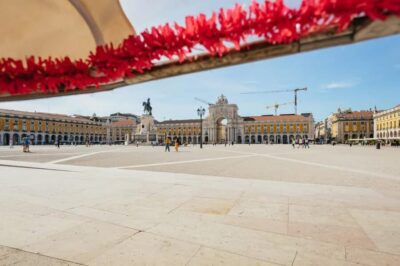
Private Guided Tuk-Tuk Tour with Hotel Pickup
Read our review →
Private Lisbon Sightseeing Tuk-Tuk Tour: Alfama, Belém & More
Read our review →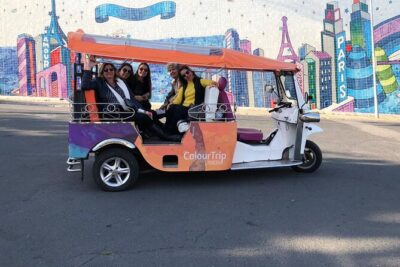
Lisbon Highlights: Private Tuk Tuk Tour Adventure Sightseeing
Read our review →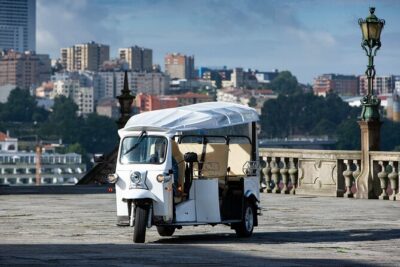
Discover Porto’s Highlights on a 2-Hour Private Electric Tuk Tuk
Read our review →
Welcome Lisbon Tour with Local Guide in Private Eco Tuk Tuk
Read our review →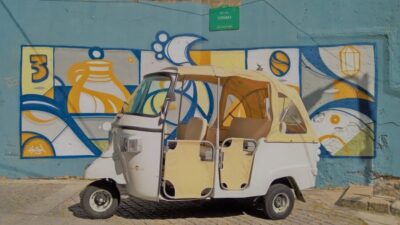
Browse the lists this tour appears in