
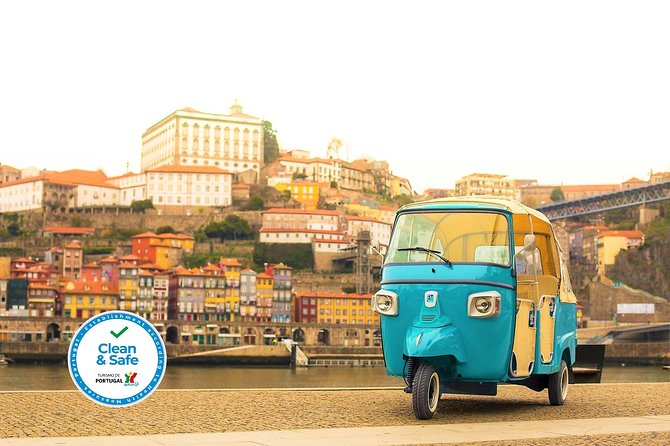
Reviewed · HISTORICAL TOURS
Porto Guided Tour to the Historical Center on a Tuk Tuk
Porto on a tuk tuk feels like fast-forward. This guided loop through the historical center is built for the kind of trip where you want big highlights plus a few quieter streets, without wearing your shoes into dust. I especially like the mix of well-known stops and lesser-seen corners, plus the little Port wine glass that keeps the pace relaxed. If you are thinking you will hear every word perfectly, do plan for one possible snag: it can be harder to catch commentary at times while driving, especially in busier areas.
Two things I really like: the tuk tuk can squeeze into narrow cobbled lanes that larger buses cannot, and the guides bring the city to life with clear, practical stories. In past tours, I heard the energy level firsthand through guides like Victor, Natalia, Anna, and Ana, and they tended to aim their facts at what you are seeing right then. The big caution for value is simple, some monument interiors are not included, so if you want to go inside multiple churches or museums, you may add a few extra tickets.
In This Review
- Key things to know before you go
- Porto by Tuk Tuk, ideal when time is tight
- Where you start, how the ride works, and who it fits best
- Price and value: what you pay for, what you may still add
- A route that strings together Porto’s “must see” and the less obvious
- From Teatro Nacional São João to the Fernandina Wall
- Porto Cathedral and the pelourinho terrace
- Paco Episcopal and a quick look into Porto’s power center
- São Bento Station and the 20,000 tile story
- Carlos Alberto Square, the Fonte dos Leões, and quick breaks
- Churches around Clerigos, plus Cordoaria Garden in between
- Clerigos Tower area: one of Porto’s signature views
- São Bento da Vitória monastery and the cultural reuse story
- Palácio da Bolsa and the Arabian Room highlight
- The monument to D. Pedro and a big-name bookshop stop
- Mercado Ferreira Borges and the Church of Gold stop
- Alfândega Nova and the transport museum link
- Serra do Pilar monastery viewpoint: Porto from across the water
- Douro bridges: forged iron and a 2003 Maillart-type arch
- Weather, timing, and how to make the most of the stops
- Should you book the Porto historical center tuk tuk tour?
- FAQ
- How long is the Porto guided tour on a tuk tuk?
- What is included in the tour price?
- Are monument entrances included?
- Is the tour offered in English?
- What if it’s bad weather?
- Is free cancellation available?
Key things to know before you go
- Port wine glass included, so you get a taste of Porto in the middle of the tour, not just at the end
- Tuk tuk access to tight streets, making the ride feel more like exploring than commuting
- São Bento Station tiles stop, including the famous narrative azulejo wall in the station lobby
- Serra do Pilar viewpoint time, with a panoramic look over both Porto and Vila Nova de Gaia
- Multiple guides seen in reviews, like Victor, Natalia, Anna, Ana, Bernardo, Gonçalo, Gabby, and Fabian, often praised for energy and clear directions
- Most monument entrances not included, so plan on photos from outside and pay only if you want interiors
Porto by Tuk Tuk, ideal when time is tight
This is a strong choice when you are in Porto for a short stay or when you want an easy first day that helps you map the city. The whole point is time efficiency. In roughly 1 hour 50 minutes, you cover a chain of areas that would take a lot longer on foot, especially if you are bouncing between hillier spots and the Douro waterfront.
I also like the vibe of this style of tour: it is not a long museum crawl. It is more like a guided “get your bearings fast” route, with short stops where you can step out for photos, a quick look, or a couple of minutes of reading on-site.
More Tuk Tuk Tours in Porto
- Porto: Guided Tour by Tuk-Tuk & Optional Douro River Cruise★ 4.5 · 5,980 reviews
- Discover Porto’s Highlights on a 2-Hour Private Electric Tuk Tuk★ 4.5 · 1,860 reviews
- Porto: Guided Tuk Tuk Tour★ 4.6 · 1,390 reviews
- Historic Porto by Private Electric Tuk Tuk to Top Landmarks★ 4.5 · 735 reviews
Where you start, how the ride works, and who it fits best
You meet at R. de Augusto Rosa 180, 4000-528 Porto, and the tour ends back at the same place. You get a mobile ticket, and the tour is offered in English.
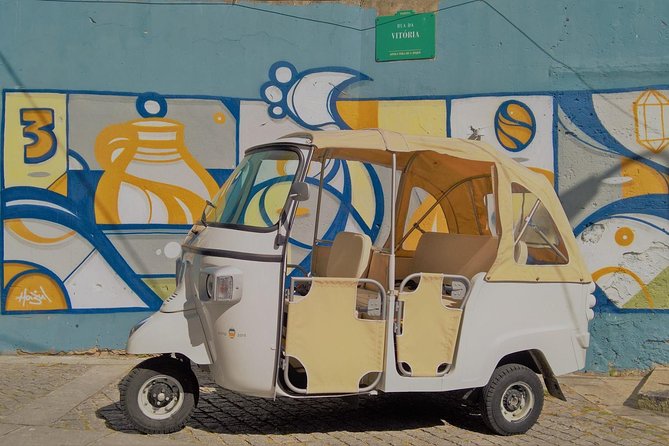
Your group rides in a tuk tuk. Each vehicle can carry 2, 3, or 4 adults of average height, up to 75 kg each. If your group is larger, the company uses multiple vehicles so you still travel together and hit the same stops at the same time.
That capacity detail matters. One review flagged that groups larger than the vehicle is built for can feel cramped, and the driver may still do their best to keep everyone included. If you are traveling as a bigger group, it is worth double-checking that you will be split into the right number of tuk tuks for everyone to sit comfortably.
Price and value: what you pay for, what you may still add
The price is $42.33 per person for the guided tour, and it runs about 1 hour 50 minutes. For me, the value here comes from two things. First, you are paying for curated routing through the historical center, not just transportation. Second, the tour includes a Port wine glass, which you would otherwise spend money on while trying to plan a busy day.
What is not included: monument entrances. That means you will often see churches, towers, and palaces from the outside or during quick stop time. If you want to go inside major sites, you will likely need to buy tickets separately.
A route that strings together Porto’s “must see” and the less obvious
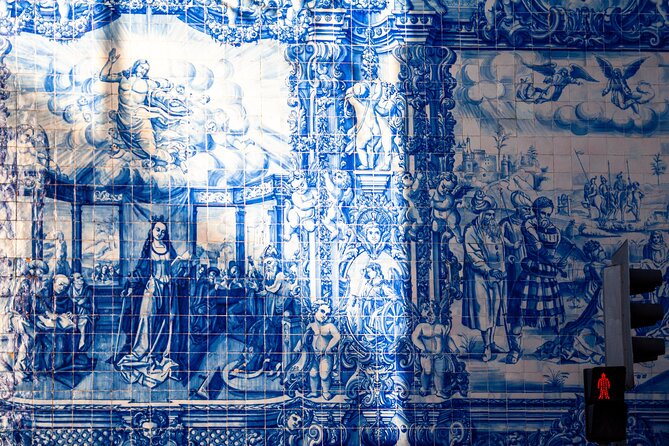
The tour starts in the central historic zone and moves through a web of landmarks that explain how Porto developed. You are not just sightseeing. You are getting a geography lesson, where hills, river views, old walls, and major religious buildings all connect.
I find that matters because Porto can feel confusing on your first day. After this kind of loop, it is easier to decide what to revisit later on your own.
From Teatro Nacional São João to the Fernandina Wall
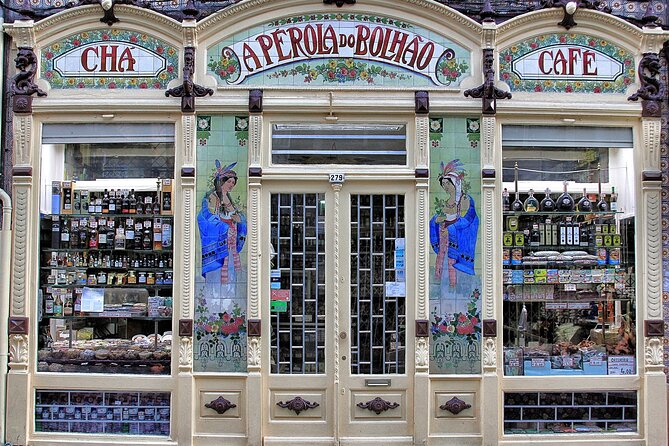
One early stop focuses on the classic theater building built in 1910 on top of the ruins of the Real Theatre, which burned in 1908. The design is linked to architect Marques da Silva, and the building is tied to the larger theatre ecosystem in the city. Even if you do not enter, it is a helpful reminder that Porto’s cultural identity shows up in architecture, not just in food and music.
Right after, you get a look at the Fernandine Wall, a military legacy built between 1368 and 1437. The guide material emphasizes how well guarded this is compared to other city landmarks, plus the scale: roughly 3000 steps and an average height around 30 feet. If you like history you can see in stone, this is the kind of stop that makes the tour feel more than a checklist.
A few more Porto days, taken slowly
Porto Cathedral and the pelourinho terrace
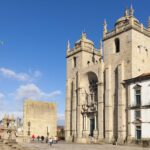
Then you roll into the Cathedral area. The Porto Cathedral dates to the 12th and 13th centuries with Romanesque roots, later enlarged over time, and ultimately shaped into an idealized medieval setting that reflects later restoration work.
Nearby, you also see the pelourinho monument in the terrace area connected to the Cathedral and Bishop’s Palace zone. The context here is practical: part of the old surrounding buildings were demolished in 1940 after a national policy during the Estado Novo period, and the terrace was created with the pelourinho stone monument installed in 1945.
You only get short time here, so think of it as orientation and photo practice. If you want deep time, you will be better off returning later to focus on one interior space.
Paco Episcopal and a quick look into Porto’s power center
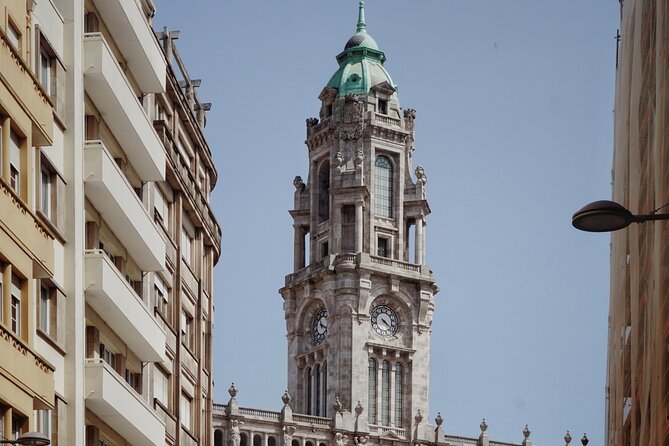
Paco Episcopal is a small but telling stop. The building is linked to earlier construction with remodeling in 1737, connected to Nicolau Nasoni in some accounts. The façade is described with a full arch and pilasters, topped with a decorated fronton, plus the bishop’s coat of arms.
This is one of those stops that works best when you are traveling with limited time. You are not trying to master architecture in ten minutes. You are seeing the shape of power and tradition, and then you move on.
São Bento Station and the 20,000 tile story
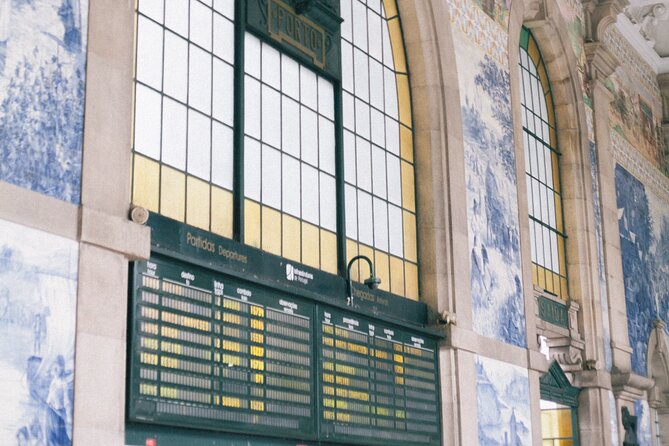
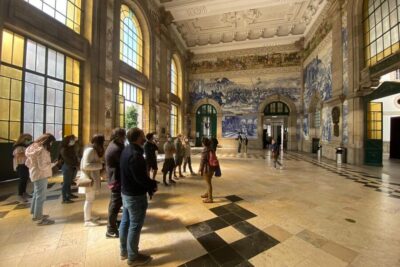
Next comes the big crowd-pleaser: São Bento Railway Station. It is in the city center and the early 20th-century design includes a glass and cast iron roof. The lobby is covered with about 20,000 narrative tiles by painter Jorge Colaço.
Even if you think you have seen photos of this place already, seeing it in person hits different. It is one of Porto’s easiest “yes, I get it” stops. It also gives you a rare indoor moment if weather turns.
Tip: if you are sensitive to crowds, go slow when you enter the lobby. People tend to line up for photos right away, so give yourself 30 seconds to find a spot with a cleaner view.
Carlos Alberto Square, the Fonte dos Leões, and quick breaks
You then pass through Praça de Carlos Alberto, a square planned from the early 18th century. It references the medieval wall limits and how the area changed once new streets and a larger square, called Praça Nova, were created.
This stop also ties to a unique storyline: the area was once known for blacksmith workshops (Praça dos Ferradores), and later the Palace of Viscondes de Balsemão became a guesthouse during the time Charles Albert of Sardinia was exiled in Porto. The square name honors him now, which is a nice example of how Porto’s map remembers unusual chapters.
Nearby you also see Fonte dos Leões, a 19th-century fountain built by a French company, cast at Val d’Osne in France. It is noted as a copy of the Town Hall Square fountain in Leicester, England. That kind of cross-city detail is exactly why this tour works for curious travelers.
Churches around Clerigos, plus Cordoaria Garden in between
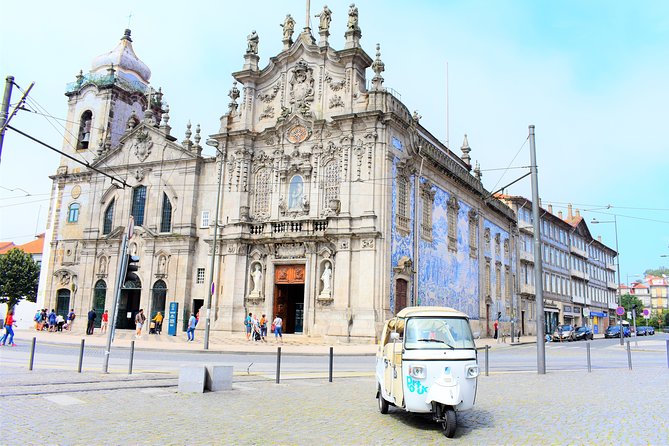
From here, the route threads through rococo and baroque architecture. The churches mentioned in the stops are tied to Nicolau Nasoni in attribution for one façade, and another is noted for tiles added in 1912 with drawings by Silvestre Silvestri that allude to Our Lady worship. Both are described as national monuments.
Because stop time is limited, treat these as “look, absorb, and decide.” If you want to go deeper, plan your follow-up visit later.
Then you reach Cordoaria Garden, also known as João Chagas Garden since 1924. The park’s identity connects to rope makers who worked nearby for around 200 years. The garden layout includes statues of Ramalho Ortigão and António Nobre, and there are sculptures tied to Porto 2001, including a work called O rapto de Ganímedes. It is a nice reset after church façades, and it gives you a pause without feeling like you are wasting time.
Clerigos Tower area: one of Porto’s signature views
Torre dos Clerigos is a central symbol of Porto. The church and tower are known for their Baroque style, and the tower is visible from multiple points around the city. The tour includes a quick stop here, which is useful because the tower tends to anchor your mental map.
If you want the tallest view, you will need to decide whether to go inside the church area or tower itself, since entrance tickets are not included in this tour.
São Bento da Vitória monastery and the cultural reuse story
The tour also passes by a monastery complex linked to Benedictine monks, with restoration efforts that allowed it to be used by the Porto National Orchestra and the Porto District Archives. The description also mentions an acoustic shell used for the “Porto 2001” cultural events.
This kind of stop feels practical. It shows how older religious spaces can shift to modern community uses without losing the architectural shell.
Palácio da Bolsa and the Arabian Room highlight
Then comes Palácio da Bolsa, the Stock Exchange Palace. It is a neoclassical building from 1842, and it is tied to the Commercial Association of Porto. Its major highlight is the Arabian Room, which is the kind of interior you likely want to see once if you can get tickets.
The palace is included in the Urban Wine Route, so it is a fitting stop right after the Port wine tasting already built into the tour. Entrance is not included, so you will mostly get exterior viewing and brief orientation unless you pay separately.
The monument to D. Pedro and a big-name bookshop stop
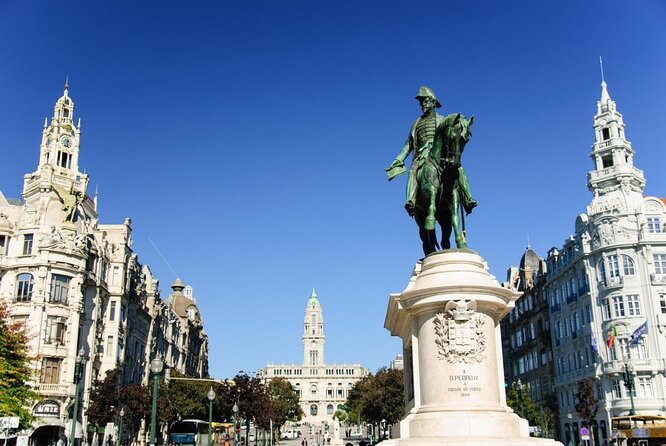
The route includes the monument tied to D. Pedro’s heart donation to Porto and the arrival in Mindelo. It was unveiled in October 1866 and includes sculptural work tied to Célestin Anatole Calmels and architecture by Joaquim da Costa Lima.
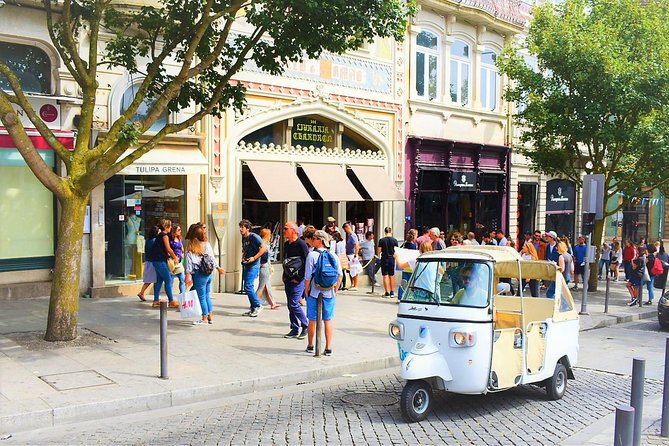
After that, you pass the building that houses Livraria Lello e Irmão, famous for its Art Nouveau façade and neo-Gothic interior details. The inside description includes painted plaster work mimicking wood, a magnificent stained-glass skylight, and a staircase that was one of the first reinforced concrete works in Porto. It is the library that both The Guardian and Lonely Planet highlighted as a stand-out beauty, including a reference to it being ranked among the most beautiful libraries in the world by The Guardian.
Again, entrances are not included, so you get a “see it and decide” moment. If you want the full experience, add your ticket separately.
Mercado Ferreira Borges and the Church of Gold stop
The tour also touches Mercado Ferreira Borges. This iron architecture market was built in 1885 to replace the old Mercado da Ribeira, and it later became renovated into an entertainment venue where Hard Club operates.
Then you get a major church stop: the Gothic Church known as the Church of Gold. Construction began in the 14th century, and it has gilded interiors from the 17th and 18th centuries. There is mention of the Tree of Jesse and catacombs, plus UNESCO World Cultural Heritage status and national monument designation.
This is the kind of place where your brain wants longer time than the tour schedule allows. Use the stop to decide what matters to you, then plan a return if you want more.
Alfândega Nova and the transport museum link
As you continue through the historic center, you reach a neoclassical building designed by engineer Jean F. G. Colson. It has two façades, one facing the Douro river and one facing the city. The later restoration and adaptation work was tied to architect Eduardo Souto Moura.
The building connects to the future Museum of Transport and Communications, and it also manages a Congress Centre in the Alfândega Nova complex. If you like cities that repurpose historic structures, this is a good stop.
Serra do Pilar monastery viewpoint: Porto from across the water
One of the most memorable moments on this route is Serra do Pilar. The monastery was started in 1538 and finished around 1670, originally for Augustinian friars. Later, during the Civil War of 1832 to 1834, the liberal army settled there. After years of neglect, restoration efforts recovered the structure, with groups created in the 19th and 20th centuries to support the comeback.
The church is circular with a dome and balcony, and the cloister is also circular, with 36 Ionic columns, described as the only example in Portugal. But the real reason people love this stop is the view. From the terrace, you can see Porto and Gaia riverside areas, including the historic center and the D. Luís I bridge.
If you catch clear weather, this is where your photos will look like you planned the trip for weeks.
Douro bridges: forged iron and a 2003 Maillart-type arch
Finally, the tour includes bridge viewpoints. You get details on D. Luís I, an iron bridge inaugurated in 1886 with two overlapping decks. Its forged iron arch is described as a world record type structure.
You also see the newer 2003 Maillart-type iron arch bridge, built to replace the upper deck lane of D. Luís I for a metro connection. The details you are given include the deck length and width, and the arch span treated as a major engineering achievement.
Even if you do not care about engineering, bridges are where Porto’s whole story becomes visible. You see how the river shaped movement, neighborhoods, and the everyday commute.
Weather, timing, and how to make the most of the stops
This experience requires good weather. If it rains, you may need to stay flexible. One review specifically called out a rainy day in a tuk tuk and recommended bringing a raincoat.
Timing-wise, most stops are short, often around 5 to 15 minutes. That means you should pick your priorities before you show up. If you want to go inside anything, you will probably need to do that on a separate visit, since monument entrances are not included.
Also, note that the tour length is approximate and can shift because of local traffic.
Should you book the Porto historical center tuk tuk tour?
Book it if you want a smart first look at Porto, with Port wine, major photo stops, and the kind of city orientation that makes the rest of your trip easier. It is especially worth it when you are on your feet all day already, because this tour keeps your walking manageable while still letting you explore.
Skip it or reconsider if your main goal is long time inside specific monuments. Since entrances are not included and stop time is brief, you will likely feel most satisfied if you treat this as your overview and plan add-on visits for interiors later.
FAQ
How long is the Porto guided tour on a tuk tuk?
It lasts about 1 hour 50 minutes.
What is included in the tour price?
The tour includes a Port wine glass, the driver/guide, and a local guide.
Are monument entrances included?
No. Monument entrance tickets are not included.
Is the tour offered in English?
Yes, the tour is offered in English.
What if it’s bad weather?
This experience requires good weather. If it is canceled due to poor weather, you will be offered a different date or a full refund.
Is free cancellation available?
Yes. You can cancel up to 24 hours in advance for a full refund.
More Tuk-Tuks in Porto
- Porto: Private Sightseeing Tour by Electric Tuk Tuk
★ 4.8 · 305 reviews - Oporto Tuk-Tuk Tour: Fast, Fun & Flexible – 1H to Full Day!
★ 4.7 · 280 reviews - Porto Half Day Private Tuk Tuk Tour
★ 4.5 · 246 reviews
What Porto sent us most recently
- Douro Tour with Wine Tasting, River Cruise and Visit to Lamego
★ 5.0 · 118 reviews - From Porto: Full-Day Douro Historical Tour
★ 4.6 · 120 reviews - Porto: Sunset Cruise on the Douro River & Iconic Bridges
★ 4.1 · 122 reviews - 4-hour Guided Porto Pub Crawl with 6 drinks and VIP CLUBentry
★ 4.5 · 124 reviews - From Porto with view to Gaia: Private Bike Tour #DuckSideOfPorto
★ 5.0 · 124 reviews - Douro Valley Half-Day Tour with Winery and Lunch From Porto
★ 5.0 · 125 reviews - Porto Food Half-Day Tour
★ 5.0 · 124 reviews - MagicTrain Tour and Port Wine Cellar Visit & Tasting
★ 3.0 · 125 reviews
Historical Tours, compared.
Historical Sites, Wine Experience, Lunch & Cruise
Read our review →
Daytime or Sunset Boat Cruise with History and Wine
Read our review →
Private Tour of the Historic City in a Ford T Car
Read our review →
Browse the lists this tour appears in