
Reviewed · SETUBAL & ARRABIDA COAST TOURS
Évora: Private walking tour with tickets to main monuments
Évora history hits fast, then keeps going. This private walking tour strings together major monuments and smaller, story-heavy corners of town, with tickets included for the Cathedral of Évora and the Chapel of Bones. I love how it blends Roman, Gothic, Renaissance, and even Inquisition-era history into one coherent route. I also like the pacing and question time, and the fact that guides such as João, Elsa, Paulo, and John are praised for making the facts click without rushing you. One drawback to plan for: it is a lot of sights in about 2 hours 30 minutes, so you will want a calm start and a steady walking pace.
You will begin at Praça do Giraldo and build out from there, seeing why Évora feels like a museum city while still being very much a working town. Expect guided stops at the Cathedral, the Roman Temple of Diana, a handful of Renaissance and Mannerist architecture, and the famous bone chapel, plus a pass along the Muralhas de Évora walls and views around the Aqueduto da Água de Prata.
In This Review
- Key highlights worth centering your day on
- Starting at Praça do Giraldo, where Évora’s story begins
- The Cathedral of Évora: Gothic scale plus a roof viewpoint
- Roman roots at the Temple of Diana, then on to Renaissance courtyards
- Chapel of Bones and the convent complex: history that feels impossible
- Mannerist details, defensive walls, and the Aqueduto da Água de Prata
- Pacing, comfort, and who this private format suits best
- Price and value: what you get for about $105.26
- Should you book the Évora private walking tour?
- FAQ
- Where does the tour start?
- How long is the private walking tour?
- Is this tour private or shared?
- What language is the tour offered in?
- Which monuments have tickets included?
- Are meals included in the price?
- Will I get a mobile ticket?
- Is free cancellation available?
Key highlights worth centering your day on
- Cathedral of Évora ticketed visit, including cloisters and a roof viewpoint over the city
- Chapel of Bones entry included, built in the 17th century with real human bones
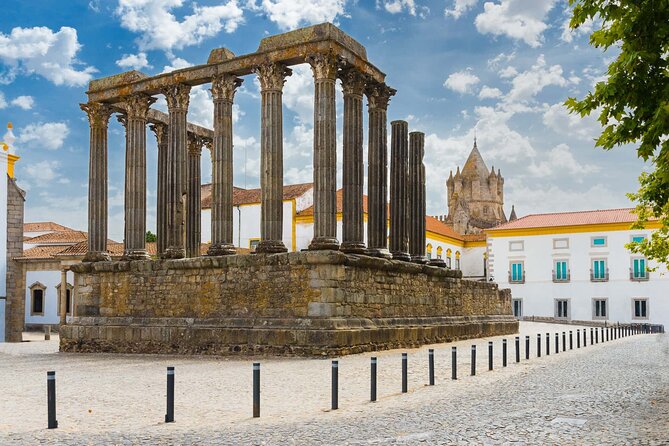
- Roman Temple of Diana (Templo Romano de Évora), about 2,000 years old and famously well preserved
- Hidden-feeling stops like Pátio de São Miguel, a tucked-away fortified courtyard tied to old orders and royal moments
- Renaissance power in stone, from the Aqueduto da Água de Prata to the Mannerist fountain inaugurated in 1556
- Defensive walls across centuries, with Roman, medieval, and later reinforcements linked to major historical periods
Starting at Praça do Giraldo, where Évora’s story begins
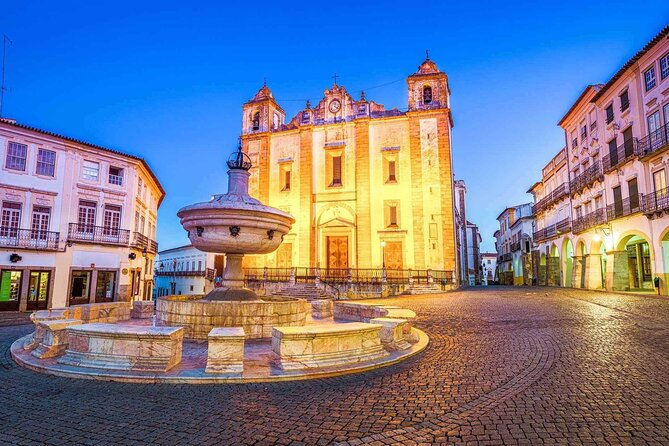
Most Évora walks start with the landmarks. This one starts with the city’s pulse. You meet by the Giraldo Square Fountain in Praça do Giraldo, and from there your guide sets the historical frame. The idea is simple: before you look up at façades, you understand what kind of city Évora was, and why it mattered in Portuguese and even universal history.
This square is described as the heart of the city since 1986, used for social gatherings and tied to economic, social, and political life. Then you get a brief, focused stop at the Homenagem as vitimas da Inquisição em Portugal, remembering how the Portuguese Inquisition began in 1536 and lasted nearly 300 years.
It can feel heavy, but it also makes the rest of the walk land better. When you later see religious architecture, Renaissance patrons, and royal spaces, you are reading them with more context instead of treating them like postcard backdrops.
Practical note: the tour moves quickly through this early stretch, so if you like to linger, plan to do extra wandering on your own after the tour returns you to Praça do Giraldo.
More of Arrabida’s chalk coast:
- Lisbon: Sesimbra Kayak Discovery Experience★ 4.9 · 1,033 reviews
- Private Lisbon Arrabida Wine Tour: Food & Wines, Mountain and Sea★ 5.0 · 907 reviews
- Setúbal: Dolphin Watching Tour★ 4.8 · 801 reviews
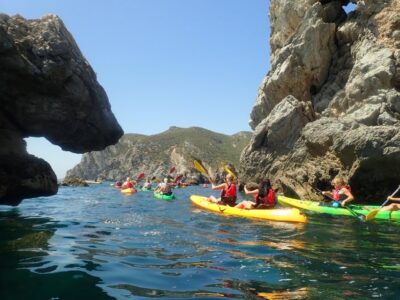
- Sesimbra: Arrabida Natural Park & Caves Guided Kayaking Tour★ 4.9 · 775 reviews
The Cathedral of Évora: Gothic scale plus a roof viewpoint
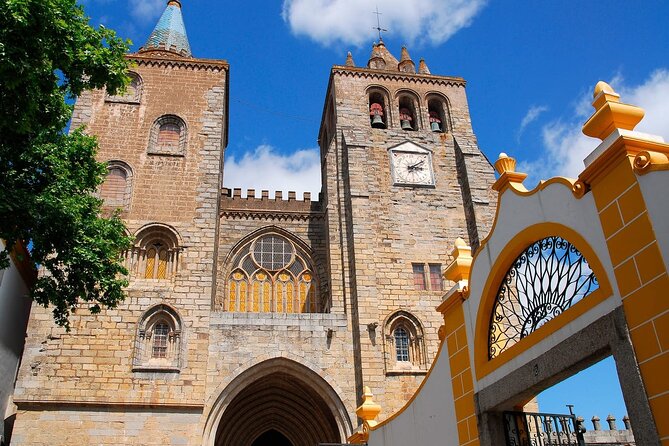
The Cathedral of Évora (Se Catedral de Évora) is the big ticket stop here, and it is included in the price. You get time to visit the Cathedral itself plus the cloisters, and you also get access to the roof for a panoramic look over Évora. That roof moment matters. It helps you connect the street-level details you just walked past with the wider city layout.
The Cathedral is described as the largest Portuguese Gothic cathedral and even compared in style to Notre Dame de Paris. Your guide also points out details described as secret messages and references to older pagan cults, which gives you permission to look twice at what you might otherwise skip.
This is also one of those stops where a good guide can prevent the usual problem. Cathedral visits often become a checklist of dates and names. Here, the structure of the visit makes it easier to understand why Gothic architecture and later layers were not random decoration, but statements of power and belief.
If you are sensitive to religious themes, or you want to keep things light, you can still enjoy this stop. You are not stuck in a lecture. You are walking through a place, then looking outward from it.
Roman roots at the Temple of Diana, then on to Renaissance courtyards
Next comes the Templo Romano de Évora, also called the Templo de Diana. This is one of the oldest and best-preserved Roman temples tied to the Roman power footprint in town. The story is that it goes back two millennia, and it is linked to the idea of a city founded in the era of Julius Caesar.
This stop is short, but it is a strong contrast to what comes next. You go from Roman scale to later Portuguese architectural styles without losing momentum. It works because your guide uses the route as a timeline you can literally walk through.
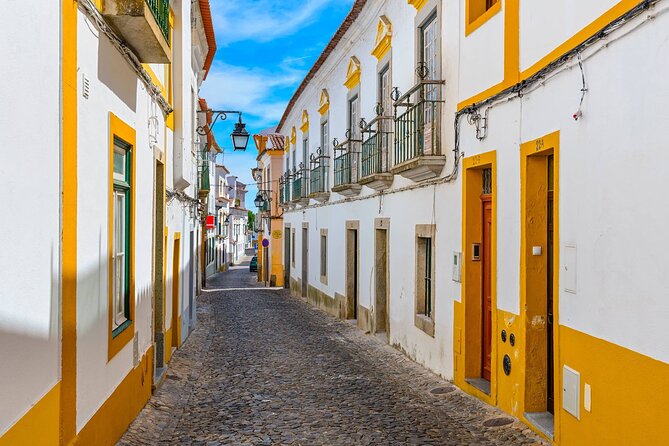
From there the tour slips into Évora’s smaller, character-rich spaces. One highlight is Pátio de São Miguel, described as one of the most beautiful spots in Évora that many visitors miss because it is tucked away. It once served as a fortified alcove for the city governor and a privileged place for kings, and it connects to older religious and military orders that later relate to the Order of Avis. If you like architecture-as-story, this is the kind of stop you will remember.
Then you see Igreja da Graça, noted for Portuguese Renaissance architecture with Mannerist inspiration. It also has the famous boys of Graça story, plus the symbolic meaning behind the hermitage’s façade. Even if you are not chasing art history specifics, these are the details your guide will turn into something you can picture.
Time savers here: this part of the route includes several quick passes and brief photo stops. That is ideal for a 2.5-hour format, but it also means you will not have the whole day to study. If you want to read stone slowly, treat this tour as the launch. Then spend later time at the stops that grab you most.
Chapel of Bones and the convent complex: history that feels impossible
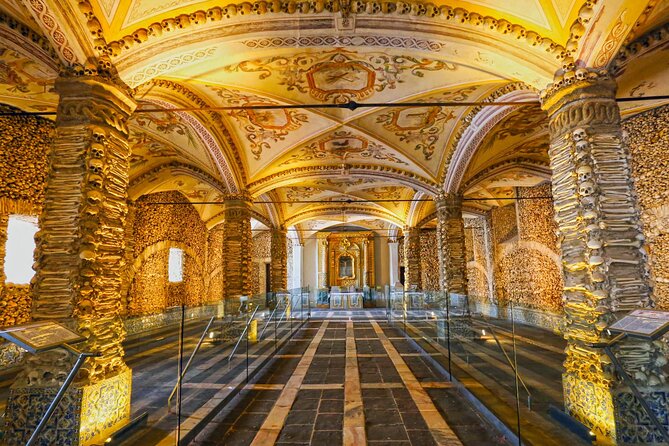
No Évora visit feels complete without the Chapel of Bones. Here, entrance is included, and the visit is allocated about 30 minutes. The concept is macabre on purpose. Its walls are covered with real human bones, belonging to thousands of people who lived in Évora, and the chapel dates to the 17th century.
The tour description uses the famous invitation to visitors, written as We, the bones that are here, await yours. Even if you have seen photos before, seeing the scale in person tends to reset your expectations. The best part is that this is handled like a meaningful historical site rather than a circus. You get legends and stories, but the visit still feels tied to place.
Right after that, the route moves to Igreja de São Francisco, once known as the golden convent. It is described as an innovative architectural work and built on an earlier Franciscan convent from the 14th century. The church served as a stage for royal weddings and baptisms tied to events that shaped Portuguese history.
Then you get Palacio de Dom Manuel, with the Ladies’ Gallery as the standout remaining section of an old royal palace complex. It is framed as romantic, and it makes sense. It is a visual reminder that Évora’s grand moments were not only about churches and wars, but also about court life.
Finally, you pass Ruinas Fingidas, a romantic arrangement of elements and ruins from a 16th-century palace. The pitch here is playful: you can ask your guide to take a picture of you in this end-of-walk photo setting. This is not about historical accuracy in the modern sense. It is about how later artists and patrons wanted to stage feeling, and that matters for understanding how Évora gets interpreted.
If you are traveling with kids, or you dislike spooky themes, tell your guide up front. You can still keep the day moving, but they can help you handle the tone in a way that fits your group.
Mannerist details, defensive walls, and the Aqueduto da Água de Prata
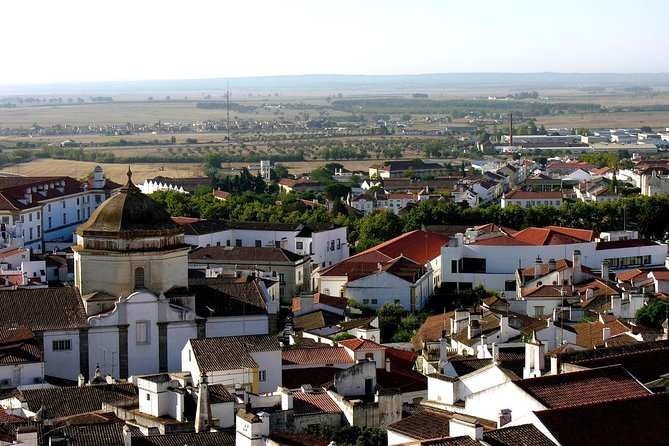
After the more intense stops, the tour shifts into power made visible. You pass the defensive walls of Évora, Muralhas de Évora, with layers from different eras. The Roman walls date to the 3rd and 4th centuries and were used by later civilizations, including Visigoths and Muslims between the 8th and 12th centuries. Then you see medieval walls from the 14th century, bastioned structures from the 17th century, and reinforcements in the early 19th century connected to the Napoleonic invasions.
Even a brief pass along walls can be useful. Walls change how you read a city. You start noticing where streets funnel, where views open, and why certain buildings feel like they were placed for defense or control.
The tour also includes Aqueduto da Água de Prata, the Aqueduct of Silver Waters. It is described as the most iconic Portuguese civil work of the Renaissance, opened in 1537 and extending about 18 km. What makes it memorable here is not only the arches. It is the way houses and urban details were inserted between its arches, giving you that Renaissance sense of progress tied to real daily life.
There is also an in-between stop for a Mannerist fountain inaugurated in 1556. It is framed as an example of Portuguese urban architecture and tied to Cardinal D. Henrique, described as a major patron of Évora and the last king of the Avis dynasty. That kind of patronage detail is the difference between just seeing a fountain and understanding why the city wanted to build it.
More Portugal at a stroll:



Pacing, comfort, and who this private format suits best
This is a walking tour that lasts about 2 hours 30 minutes, with a moderate physical fitness level noted for travelers. It is private, so your guide can slow down for questions, adjust pacing, and tailor the walk. That is a big deal in a compact route like this one, because Évora’s highlights are close but not identical.
It also helps that the tour is offered in English and uses a mobile ticket. That means you are not juggling paper, and the included entries are already part of the plan.
Who this suits best:
- If you want a structured introduction to Évora in one go, without building a route yourself
- If Cathedral of Évora and Chapel of Bones are on your list and you want the tickets handled
- If you like guided storytelling that connects architecture to politics and everyday life
- If you prefer a slower, question-friendly pace instead of a rushed group tour
Who might want to think twice:
- If you like to linger for long periods inside each monument, the schedule may feel tight. In that case, use this as your foundation, then return to your favorite 1 to 2 spots for a deeper self-guided visit.
Price and value: what you get for about $105.26
At $105.26 per person for a private 2.5-hour walk, the price is not “cheap.” It is also not random. Your money largely goes toward guide time plus paid entry for the two biggest indoor, high-demand stops.
The Cathedral of Évora and the Chapel of Bones both have entrance tickets included. The rest of the route is mostly free-access streets and exterior views, plus several short internal moments described as free admission. In other words, you are paying for someone to set the sequence, interpret the details, and manage the ticketed sites.
You also get mobile ticket convenience and a private group experience. Reviews in the supplied material strongly emphasize that guides like João, Elsa, Paulo, and John keep the tour engaging, answer questions, and sometimes even customize based on interests. That kind of customization tends to be worth more than saving a few euros, especially in a compact, history-dense city.
Another small value signal: the tour is commonly booked around 52 days in advance. That suggests it is not a throwaway add-on. When you want a guide for a tight timeline, availability can matter.
Should you book the Évora private walking tour?
Yes, if you want an efficient, story-driven overview that hits the major monuments without turning your day into a DIY scavenger hunt. I would book it if Cathedral of Évora and the Chapel of Bones are must-dos for you, because tickets are included and the walk makes sense as a timeline of Roman, medieval, and Renaissance Évora.
I would skip or at least reconsider if your top priority is slow museum-style reading inside every site. This route is designed to cover a lot ground in one afternoon. You can always come back afterward, but this tour is built for momentum.
If your schedule is flexible, use the free cancellation window for peace of mind. And if you are choosing a time slot, aim for the part of the day when you can comfortably handle about 2.5 hours of walking in the historic center.
FAQ
Where does the tour start?
The tour starts at Giraldo Square Fountain, Praça do Giraldo 7, 7000-508 Évora, Portugal.
How long is the private walking tour?
It lasts about 2 hours 30 minutes.
Is this tour private or shared?
It is a private tour/activity, so only your group participates.
What language is the tour offered in?
The tour is offered in English.
Which monuments have tickets included?
Entrance tickets are included for the Chapel of Bones and the Cathedral of Evora.
Are meals included in the price?
No, meals are not included.
Will I get a mobile ticket?
Yes, the tour includes a mobile ticket.
Is free cancellation available?
Yes. Free cancellation is available, and you can cancel up to 24 hours in advance for a full refund.
If you want, tell me when you’re visiting (month is enough) and what you care about most, Roman, Gothic, Renaissance, or the spooky stuff, and I will help you plan the rest of your Évora day around this tour.
What Setubal sent us most recently
- Coasteering in the Arrabida Natural Park (Lisbon region)
★ 5.0 · 123 reviews - Lisbon: Arrábida Kayak and Coasteering Adventure Tour
★ 5.0 · 130 reviews - Lisbon: Kayak Tour Arrábida Natural Park, Setubal, Sesimbra
★ 4.9 · 135 reviews - Coasteering at Portinho da Arrábida
★ 5.0 · 139 reviews - Kayak Adventure in Sesimbra – The Heart of Arrábida Natural Park
★ 5.0 · 145 reviews - Sesimbra: Secret Bays and Beaches Boat Tour with Snorkeling
★ 5.0 · 146 reviews - Dolphin watching in Setúbal
★ 5.0 · 146 reviews - Sesimbra : Guided Kayak Tour in Arrábida Natural Park & Caves
★ 5.0 · 153 reviews
Setubal & Arrabida Coast Tours, compared.
Private Lisbon Arrabida Wine Tour: Food & Wines, Mountain and Sea
Read our review →

Sesimbra: Arrabida Natural Park & Caves Guided Kayaking Tour
Read our review →
Arrabida and Sesimbra Small-Group Day Trip from Lisbon with Wine Tasting
Read our review →
Private Lisbon-Arrábida Wine Tour: 3 Wineries, Coast & Heritage
Read our review →Browse the lists this tour appears in