
Reviewed · WALKING TOURS
Historical Walking Tour of Lisbon
Lisbon is built on layers, and this walk helps you read them fast. You start in Rossio, then move through the city’s big squares and streets with a guide who ties each stop to the key turning points that shaped Lisbon.
I like this tour for its story-first approach, not just sign-to-sign sightseeing. I also love that you get a small group feel and practical help, including local food and sightseeing suggestions you can use the same day.
One thing to consider: it is a classic hill-and-cobbles city walk. If you are sensitive to uphill stretches and uneven stone sidewalks, you will want sturdy shoes and a slower pace.
In This Review
- Key highlights at a glance
- Rossio Square, Praça Dom Pedro IV, and Lisbon’s 3,000-year opening chapter
- Praça da Figueira and the 1755 earthquake, plus the crown battles
- Rua Augusta, Lisbon’s main artery, and Enlightenment-era architecture
- Praca do Comercio (Terreiro do Paco): discovery stories and rebuild heroes
- Chiado, poet territory, and the oldest bookshop in the world
- Largo do Carmo and Convento do Carmo, Lisbon’s memory that still stands
- Elevador de Santa Justa area: a viewpoint break and local tips for your next steps
- How the 2 hours 45 minutes feels on foot (and what to bring)
- Price and value: why $3.62 is such a bargain (if it stays consistent)
- The guides make the difference: storytelling you can remember
- Who this Lisbon walking tour is best for
- Should you book this historical walking tour of Lisbon?
- FAQ
- What is the duration of the Historical Walking Tour of Lisbon?
- How much does the tour cost?
- Where do I meet the guide, and where does the tour end?
- Is the tour offered in English?
- Do I need a ticket on my phone?
- How large is the group?
- Does it run only with good weather?
- Can I get a full refund if my plans change?
- Are service animals allowed?
Key highlights at a glance
- Rossio Square to the city’s oldest timeline, starting with the area’s very early inhabitants
- The 1755 earthquake thread, woven through Praça da Figueira, Terreiro do Paço, and beyond
- Rua Augusta as Lisbon’s main artery, plus Enlightenment-era architecture context
- Chiado stops with book-and-poet energy, including a chance to visit the oldest bookshop in the world
- Convento do Carmo and the Carnation Revolution, a huge moment in modern Portuguese history
- A downtown viewpoint break near the Elevador de Santa Justa area to reset your legs
Rossio Square, Praça Dom Pedro IV, and Lisbon’s 3,000-year opening chapter
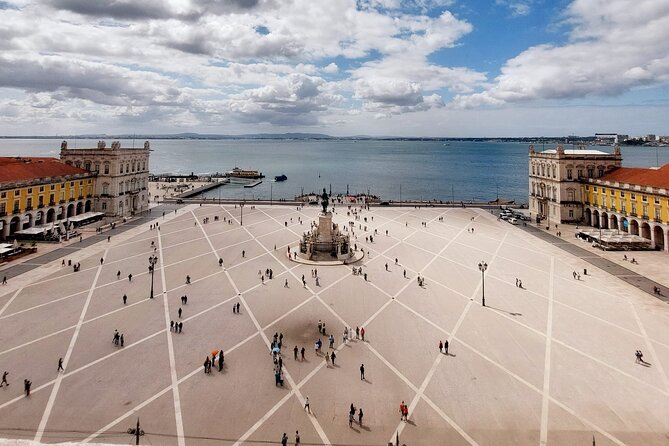
Most Lisbon tours start with a map. This one starts with time. You begin at Praça Dom Pedro IV, also known as Rossio Square, where the ground itself gives you a clue that Lisbon is not a modern city. Expect a focus on the area’s very early inhabitants, plus what the square’s design says about how the city grew.
Rossio is also a smart starting point because it is easy to orient yourself. Before you know it, your brain starts connecting street corners, sight lines, and that constant Lisbon feeling of you are both on a street and looking toward a bigger story.
If you have ever felt overwhelmed by Lisbon’s hills and overlapping neighborhoods, this beginning helps. You get a framework you can carry with you as you move downhill, then uphill, then downhill again.
More Walking Tours in Lisbon
- Lisbon: History, Stories and Lifestyle Walking Tour★ 4.8 · 10,902 reviews
- Best of Lisbon Small-Group Guided Walking Tour★ 5.0 · 4,869 reviews
- Lisbon: Food and Wine Small Group Walking Tour★ 4.9 · 4,082 reviews
- Best of Lisbon Walking Tour: Rossio, Chiado & Alfama★ 4.9 · 2,700 reviews
Praça da Figueira and the 1755 earthquake, plus the crown battles
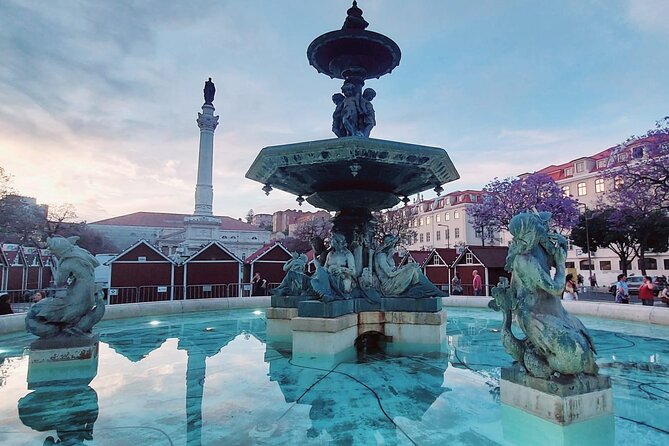
Next comes Praça da Figueira, a square that is easy to miss if you are just passing through. Here, the guide anchors the area to what used to be there, including the largest public hospital that was destroyed in the 1755 earthquake.
This stop also adds political context. You will hear about battles over the crown, and how Portugal faced pressure from neighboring powers. That mix matters because Lisbon’s architecture and monuments make more sense when you know who was fighting, who was rebuilding, and what they were trying to protect.
Practical note: you spend about 15 minutes here. It is long enough to make the square feel meaningful, but not so long that you get stuck waiting for the rest of the group.
Rua Augusta, Lisbon’s main artery, and Enlightenment-era architecture
From there, you walk through Rua Augusta, Lisbon’s emblematic central street. This is one of those routes that feels like a shopping corridor until the guide gives you a lens. You start paying attention to how the Age of Enlightenment influenced the area’s architecture and the overall logic of the rebuild.
Rua Augusta is useful for another reason. It is the kind of street that helps you understand how Lisbon routes foot traffic. Once you walk it once with context, you will recognize the street’s role when you return later for a meal, a viewpoint, or a last stroll.
Keep your expectations realistic. This portion is energetic and busy compared to the squares. If you want quiet photography, you will likely do better at the edges of the street rather than dead center.
Praca do Comercio (Terreiro do Paco): discovery stories and rebuild heroes
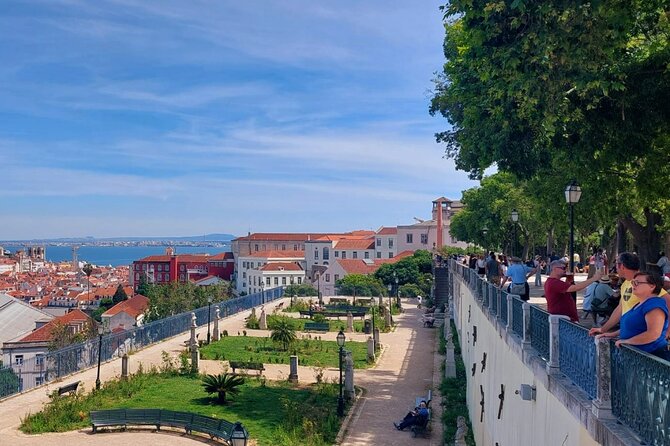
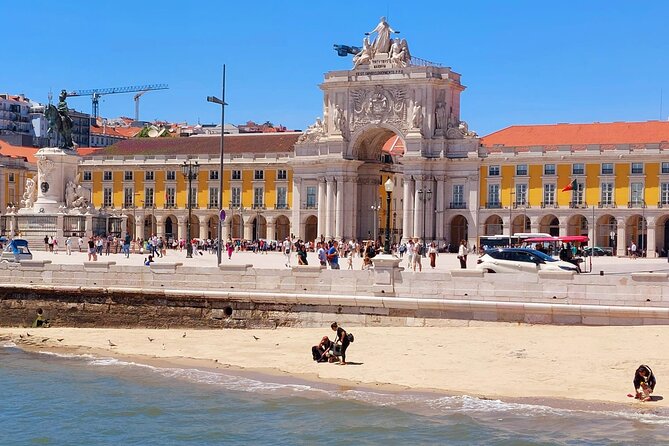
Soon you reach Praca do Comercio, also called Terreiro do Paco, Lisbon’s main square and the historic entry point to the city. This is where the tour’s bigger themes start to click: the city as a gateway, then the city as a rebuilt statement.
You will hear stories tied to the Age of Discovery and the massive disruption of the 1755 earthquake, then how Lisbon’s rebuilding efforts pushed forward with heroes and major plans. It is a lot to process in one square, but the pacing helps. You get time to look around, not just listen while walking.
This is also a great place to pause and check your footing. The square is open, so it is easier to step back, regroup, and see the layout that connects to the streets around it. If you like architecture, this stop alone can justify the tour.
Chiado, poet territory, and the oldest bookshop in the world
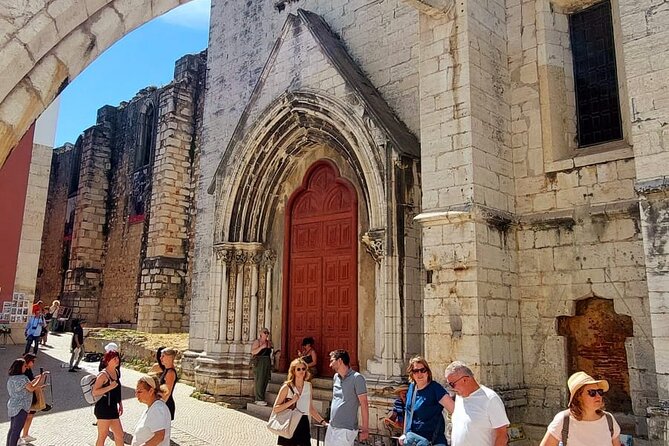
Then you shift into Chiado, Lisbon’s art and literature side. The guide frames it as a place where cafes, theaters, bookshops, and nightlife energy all meet. It is less about one monument and more about a neighborhood mood.
You will hear stories tied to Portuguese poets and writers, which is a fun way to understand why this district feels like Lisbon thinks in ideas. The highlight for many people is the chance to visit the oldest bookshop in the world, which turns the neighborhood into a living time capsule.
Even if books are not your thing, this is still a good stop for two reasons. First, Chiado gives you a break from pure history talk and a sense of daily Lisbon culture. Second, it helps you pick where to wander next, since the cafés and side streets around here are the kind you will want to explore on your own later.
More Portugal at a stroll:



Largo do Carmo and Convento do Carmo, Lisbon’s memory that still stands
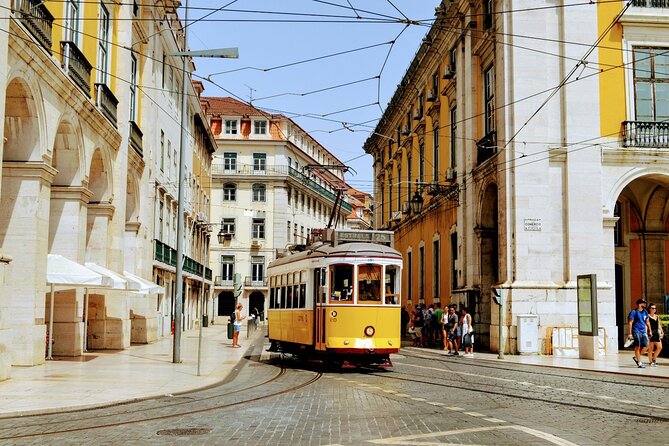
Next is Largo do Carmo, anchored by Convento do Carmo. This stop carries a lot of meaning because it is described as the second oldest building in the city and one that barely resisted the 1755 earthquake.
Here, the history keeps moving into modern times. You will hear about Convento do Carmo as a key social gathering place, including the 1974 Carnation Revolution, often described as a cool turning point in world history. Even if you only know the revolution by name, the context makes it feel real and local, not like a distant headline.
This is also a stop where your eyes can rest. It is not just another square; the building presence changes the way the space feels. You will likely look longer than the allotted time because the setting invites it.
Elevador de Santa Justa area: a viewpoint break and local tips for your next steps
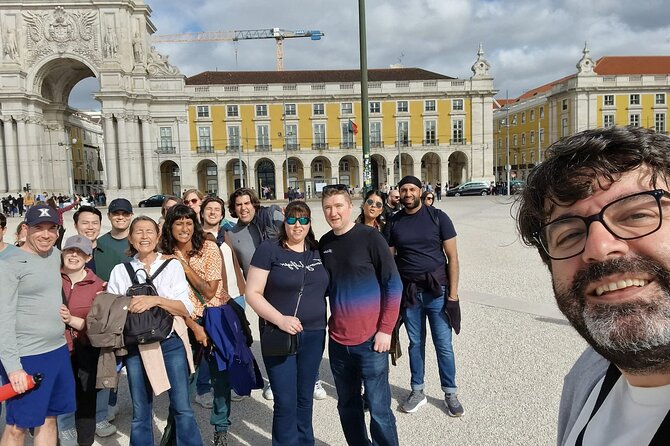
The tour finishes near the Elevador de Santa Justa area, with time to catch views over downtown Lisbon. This is not just a reward for walking. It is strategic. Getting your eyes on the city layout helps you plan the rest of your trip with less guesswork.
You will also get the kind of advice that saves time later, like suggestions for local food and viewpoint ideas. The best part of these recommendations is that they are usually grounded in what the guide thinks is worth your effort, not a generic list.
One more practical detail: this end point is in the upper part of downtown and you will get a nice sense of the city center from there. It is a clean way to finish a walking tour, especially if you want to immediately keep exploring afterward without figuring out a new transit plan.
How the 2 hours 45 minutes feels on foot (and what to bring)
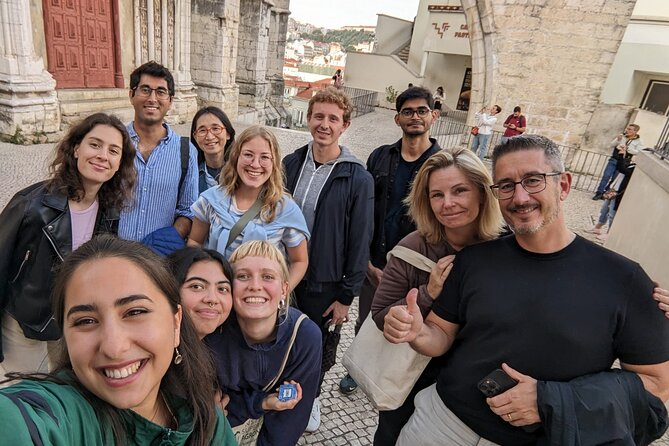
The tour is about 2 hours 45 minutes and capped at 20 travelers. That small-group size matters more than you might think. You can ask questions, the guide can adjust pace a bit, and you are less likely to get lost behind a big crowd.
What should you bring? From the kinds of notes people repeat after this tour, the big winners are simple:
- Comfortable walking shoes for cobblestones and uneven sidewalks
- A water bottle (Lisbon can surprise you with heat)
- Sunscreen, since you are out walking through open squares and streets
Also, come with a mindset that you are learning to read the city. This is not only about landmarks. It is about why those landmarks matter, which means you may slow down a bit at stops to take it in.
Accessibility-wise, most travelers can participate, and service animals are allowed. The route does include walking and some uphill elements, so if mobility is an issue, plan for a slower pace and consider a backup plan.
Price and value: why $3.62 is such a bargain (if it stays consistent)
The listed price is $3.62 per person, and that is the first thing I check because I want to know what you actually get for it. Here, you get a professional guide, plus hand-picked suggestions to enjoy Lisbon. All the stops are marked as admission ticket free, which keeps the day from turning into surprise add-ons.
Is $3.62 realistic across seasons and providers? Prices can change, so you should confirm the current total when you book. Still, as an idea, this setup is strong value: you are paying for interpretation, direction, and a planned route through the city’s most important early-modern story arc.
If you like spending your first hours in a new city with a guide who can connect squares to the big events, this pricing structure is exactly how you stretch your travel budget.
The guides make the difference: storytelling you can remember
What consistently comes through is the way guides tell stories and keep them easy to hold onto. Names that show up in praise include Logan, Nuno, Bruno, Kiara, Constanca, Andre, Antonio, and Tomàs. The common thread is pacing plus personality, and the ability to answer questions without sounding like a script.
You should also expect that guides will tailor a little. Some people specifically note getting lists of suggestions for what to do next and helpful restaurant or shop recommendations afterward. Even if you already have plans, these kinds of suggestions can steer you toward simpler choices, like where to eat near your next stop rather than fighting transit.
One extra detail that comes up in fun facts is a surprising connection around Portugal and Nobel history, tied to the inventor of the lobotomy. Even if you treat it as a conversation-starter rather than a test question, it shows the tour’s tone. Expect history with personality, not just dates.
Who this Lisbon walking tour is best for
This tour fits best if you want:
- A first-time Lisbon introduction that goes beyond a photo checklist
- A guided route through the city’s central story beats, including the 1755 earthquake and rebuild
- A balance of big-sight walking and small-context stops, like Chiado’s literary vibe and Convento do Carmo’s modern significance
It is not the best match if you want to do minimal walking, or if you dislike historical context. People who enjoy learning and talking usually get the most out of it.
If you are traveling with a teen or younger adult, the best sign is whether they can handle a steady walking pace and open squares for pauses. Families often do well when the guide checks pace and keeps the stories lively.
Should you book this historical walking tour of Lisbon?
Yes, I think you should book this if your goal is to get your bearings fast and understand why Lisbon looks the way it does. The itinerary focuses on the exact places that shape the city’s identity, and the guide storytelling style makes the material stick.
Book it especially if you value a blend of:
- landmark viewing plus clear historical context
- practical local tips you can use right after the tour
- a small group setting that makes questions feel normal
Skip it if you want a slow, casual stroll with minimal explanation. This is a walking tour with momentum and ideas, and the best results come when you lean into the story.
FAQ
What is the duration of the Historical Walking Tour of Lisbon?
The tour lasts about 2 hours 45 minutes.
How much does the tour cost?
The listed price is $3.62 per person.
Where do I meet the guide, and where does the tour end?
You start at Rossio Square, Praça do Rossio, 1100-200 Lisboa, Portugal. You end at the Carmo Archaeological Museum, Largo do Carmo, 1200-092 Lisboa, Portugal.
Is the tour offered in English?
Yes. The tour is offered in English.
Do I need a ticket on my phone?
Yes. It is listed as a mobile ticket.
How large is the group?
The tour has a maximum of 20 travelers.
Does it run only with good weather?
This experience requires good weather. If it is canceled due to poor weather, you will be offered a different date or a full refund.
Can I get a full refund if my plans change?
Yes, free cancellation is available up to 24 hours in advance for a full refund.
Are service animals allowed?
Yes. Service animals are allowed.
More Historical Tours in Lisbon
- Lisbon: Daytime or Sunset Boat Cruise with History and Wine
★ 5.0 · 1,053 reviews - Explore Lisbon by Tuk Tuk: History and Viewpoints
★ 5.0 · 840 reviews - Private Tuk Tuk Tour Through Lisbon’s Historical Streets
★ 5.0 · 734 reviews
What Lisbon sent us most recently
- From Lisboa: Sintra, Cabo da Roca & Cascais Private Full Day Tour
★ 5.0 · 39 reviews - Best of Sintra and Cascais Private Full Day Tour
★ 5.0 · 39 reviews - Private Sailing tour in Lisbon – Day Time, Sunset and Night
★ 4.5 · 39 reviews - Tuk Tuk Lisboa – Sightseeing Tours
★ 4.5 · 39 reviews - Private Experience Óbidos Nazaré and Fátima or Aveiro and Óbidos
★ 5.0 · 39 reviews - Belém and Jerónimos Monastery Private Walking Tour & Ticket
★ 4.5 · 39 reviews - Lisbon Private Luxury Tour
★ 4.5 · 39 reviews - Exclusive Lisbon Progressive Dinner & Wine Tour
★ 5.0 · 40 reviews
Walking Tours, compared.

Best of Lisbon Small-Group Guided Walking Tour
Read our review →

Porto Walking Tour, Lello Bookshop, River Cruise and Cable Car
Read our review →

Best of Lisbon Walking Tour: Rossio, Chiado & Alfama
Read our review →
Experience Porto’s Charm: 3-Hour Guided Walking Tour
Read our review →
Enjoy a Guided Levada Walk in the Rabaçal Valley
Read our review →Browse the lists this tour appears in